Tag

Indian food

Browsing

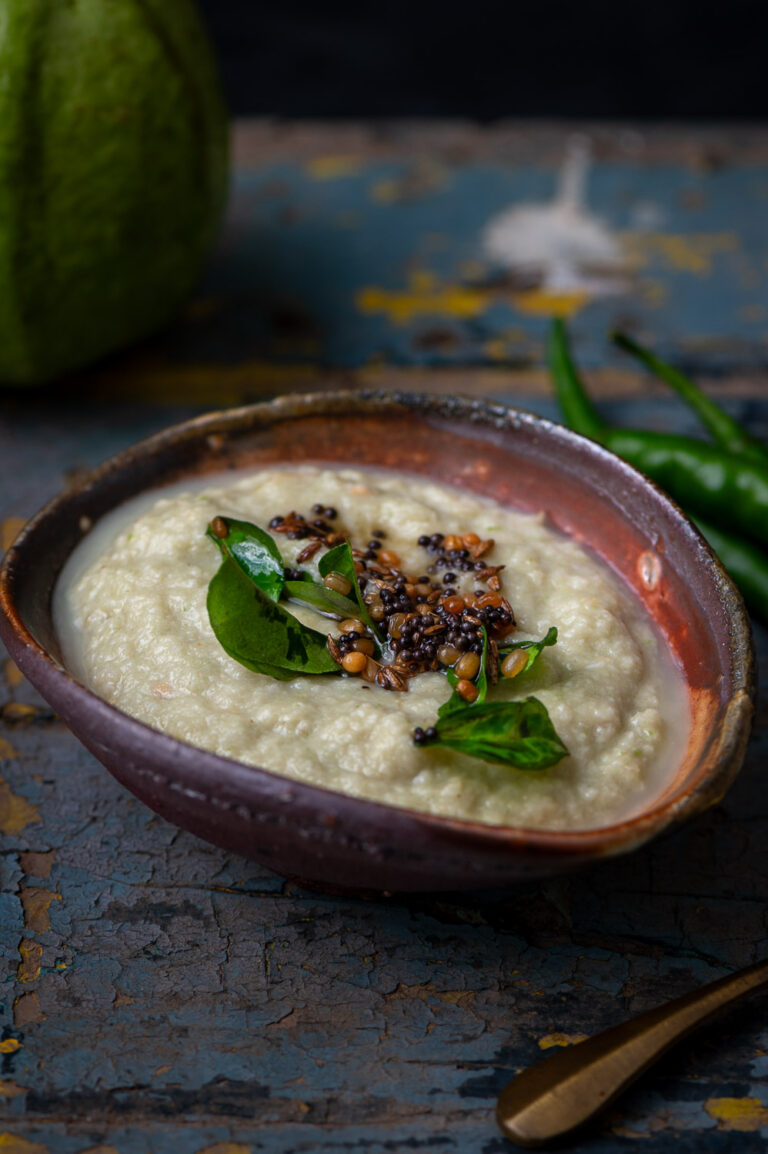
The delicious guava fruit has made a couple of appearances on my blog before: in the recipe for a popular Gujarati guava curry, as well as in a lovely Parsi guava jelly. Guava is something I have always enjoyed in various forms, and is linked to special childhood memories of climbing neighbourhood trees and plucking the fruit – eating it that fresh, and in such a fun way too. Having grown up in Chennai and having seen the abundant growth of the tree right here in the city, it occurred to me that there had to be regional dishes that feature it too. Upon speaking to Tamilian friends, I learnt about the guava chutney. I had initially been pleasantly surprised even by the concept of a chutney being made from a fruit. Preparing it had been on my mind for some time, and then a beautiful coincidence occurred. I’m so glad to be able to share both the recipe and the story today, in the last few weeks before I wind this blog down for good.

The beautiful coincidence I mentioned is this… As with several of the recipes I have shared here over the years, I often enjoy doing a few experiments and a bit of research before I bring a dish to you. I had been mulling a South Indian guava chutney recipe for a while. I had decided some months ago that I would settle on a good guava chutney recipe and share it here, so imagine my sheer delight when I encountered it during some travel last week. Just in time, and just so delicious!

I had been visiting Thanjavur and stayed in a village, where I was thrilled to experience the local cuisine. A lady there who was cooking for us prepared some amazing food, and amongst the spread was guava chutney.

Naturally, I asked her for the recipe and even requested that I watch her prepare it. What you read here today is a recipe for authentic Tamil-style guava chutney from the Thanjavur delta.

Guava has its own distinct flavour, which this chutney brings this out beautifully. In addition to being tasty, it is also nutritious. It is rich in fibre and antioxidants, and is known for an extensive range of benefits – everything from boosting cardiac health to boosting collagen in the skin. It is a good source of vitamin C, which is why it has a tanginess to it. You can avoid lime as an ingredient entirely while making this chutney. A small piece of tamarind enhances it, but this is the only addition of an acidic note.

In the past, I found hybrid guava varieties on the market, imported from Thailand, but I have noted that they are also being cultivated in India now. The hybrid kind is pink on the inside all year round, and you can find them all year round too. They look very attractive but are not necessarily sweet, although I understand why their easy availability makes them appealing. As much as I relish all kinds of fruit and also have out-of-season cravings, I do prefer to lean towards the traditional and organic. I wish to plant more guava trees on our farm, and I’m eager to find native variants, or at least those that have long been grown here.
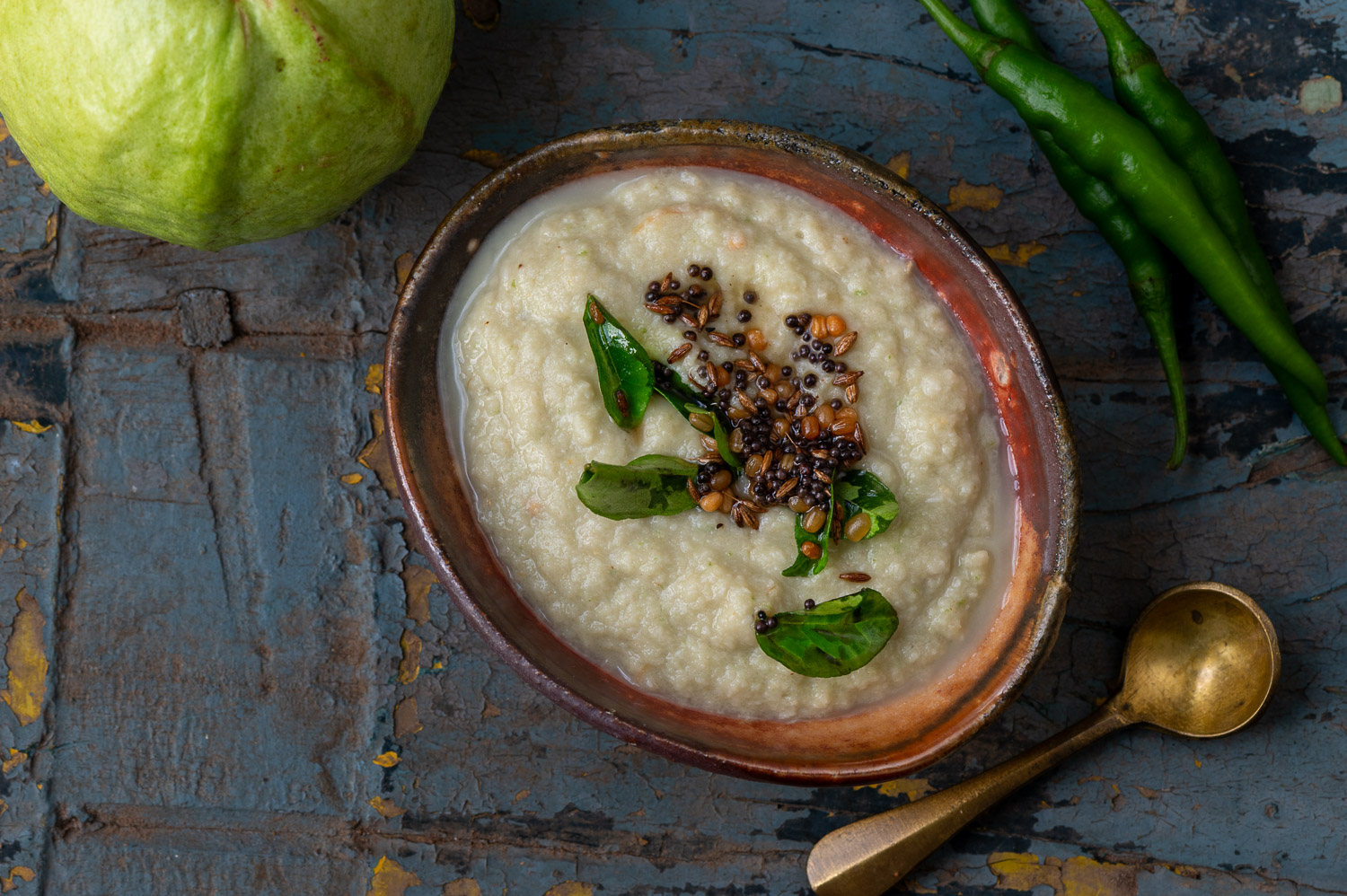
Guava Chutney
(Yield: Serves 2-4)

125 grams guava
2 green chillies
2 tablespoons grated coconut
2-3 cloves garlic
½ inch piece of ginger
1 inch piece of tamarind (soaked)
Salt to taste
Water as required

Tempering

2 teaspoons oil
½ teaspoon mustard seeds
½ teaspoon cumin seeds
A pinch of asafoetida

In a blender, add the guava, green chillies, grated coconut, garlic, ginger, tamarind and salt. Add ¼ cup water or as required.  Blend until smooth.

To prepare the tempering, heat the oil and add the seeds. When they splutter, add asafoetida. Pour this tempering over the chutney and serve. You will probably enjoy it most with dosas or rice.

As you can see, the recipe is really very simple. Guava chutney adds a fruity, flavourful note to any basic Indian meal of yours, complementing the staples and bringing a bit more joy to the day. If you enjoy chutneys in general, do check out more of them in the archives too.
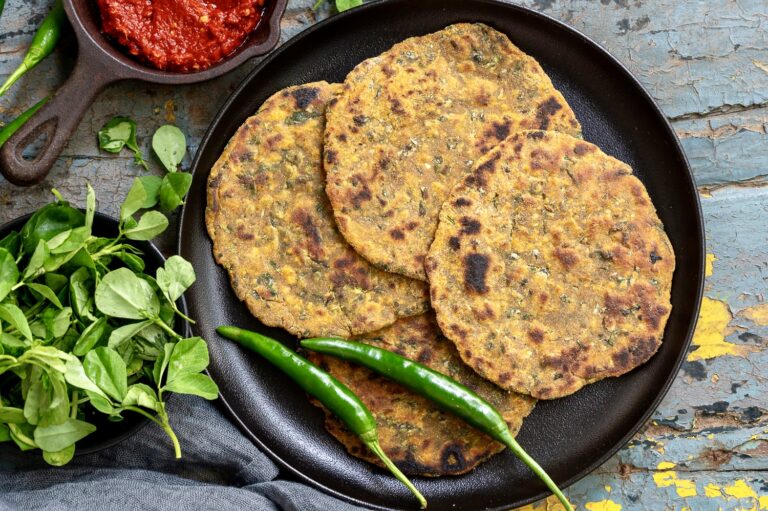
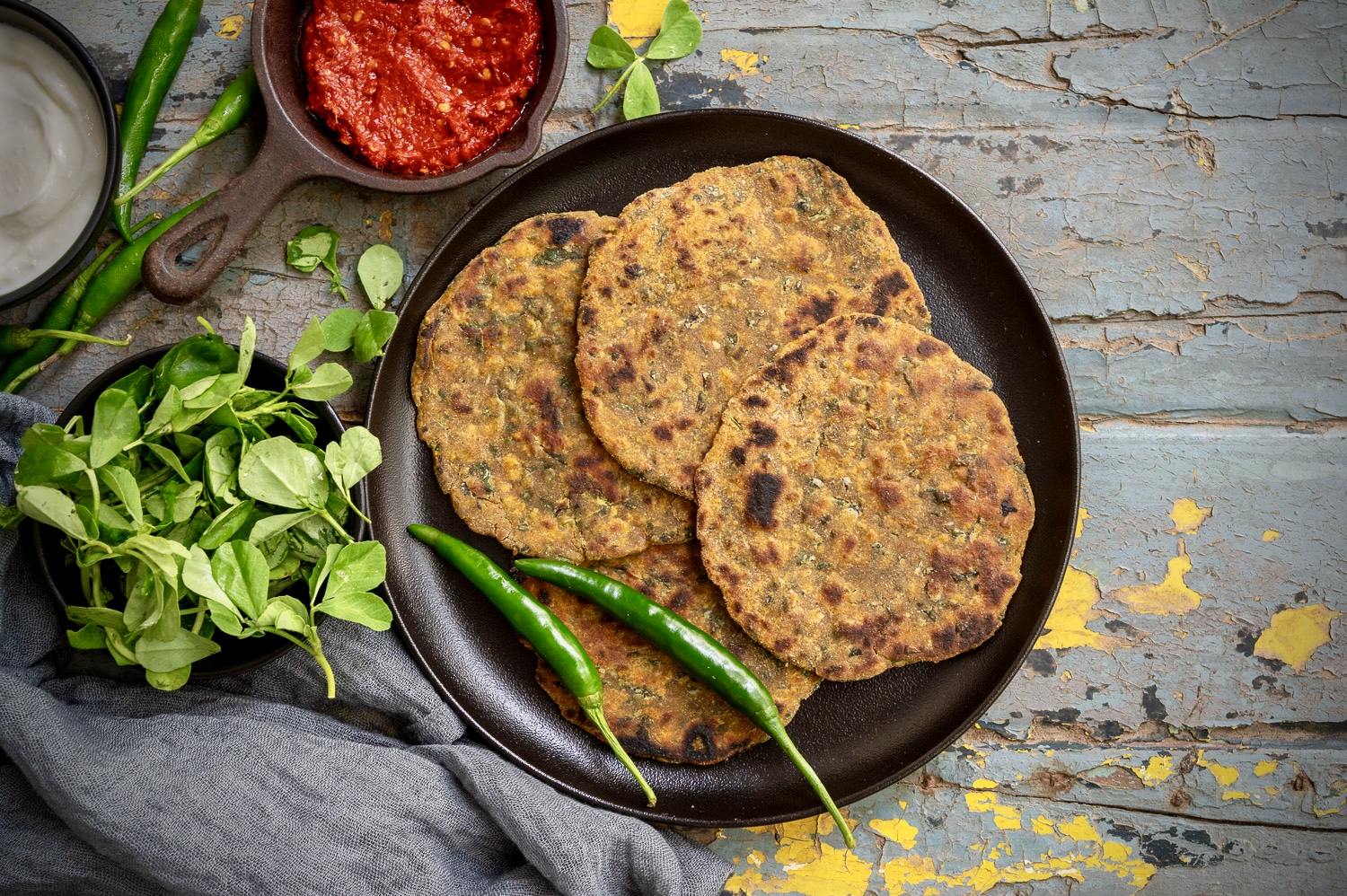
Even within a larger community, sub-communities often have their own methods of culinary preparation. I was born into a Vaishnav Gujarati family, and married into a Jain Gujarati one. When I came into my marital home, I began learning the nuances between the sub-cuisines from my mother-in-law. She also introduced me to recipes which I had not been familiar with earlier, including one for some cherished sweet-savoury pea-pomegranate kachoris, shared on this blog close to a decade ago. I am glad to share another one today: methi na dhebra, which is a kind of flatbread, and is in this iteration infused with nutritious fenugreek leaves.

My mother-in-law had an interesting way of making dhebras: rather than prepare them as flatbreads, she would hand-make them in a dumpling fashion, which would be cooked in a yogurt-based gravy that had to be eaten fresh off the stove. Her dhebras were made by repurposing leftovers, specifically theplas and rice. This is a skill I have always admired, one that is common across India, and which inspired my “Second Helpings” recipe series. Traditionally, however, the dhebra is a flatbread made of pearl millet, or bajra, which like most flatbreads keeps for a little while and thus travels well too. That is what I am sharing today.

You will notice that it is distinct from thepla: thicker, more coarse and slightly crispy. It is made of easily available and affordable ingredients, and is very filling. It requires just some curd or pickle on the side.

Although my mother-in-law’s unique twist on dhebra was something new to me, I had eaten the traditional version numerous times while growing up. My mother would prepare it as a one-dish dinner, especially when she was having busier days. My siblings and I would pull a long face whenever we saw it, not realizing at the time that it was pure, wholesome goodness. There were no gimmicks of protein, fibre or other important elements being had separately. It was an all-in-one wonder, like some of our simplest Indian dishes can be. I am going back to those old recipes now, and I hope they’ll never go out of style again.

What makes this particular dhebra extra nourishing is that I use fenugreek leaves in it, also known as methi. This crop is seasonal, so when you can’t get fresh leaves, dry leaves work just fine. You can also substitute it altogether with bottle gourd. You may also wish to incorporate garlic, which is eliminated altogether in many Jain households. All in all, you will get a flavourful flatbread that you can enjoy immediately, or pack into a lunchbox for later.

Methi Na Dhebra
(Yield: 6-8 pieces)

1 cup bajra (pearl millet) flour

¼ cup whole wheat flour

1 tablespoon yoghurt

1 teaspoon ginger-green chili paste

Salt to taste

¼ teaspoon turmeric powder

½ teaspoon cumin powder

½ teaspoon coriander powder

2 teaspoons oil

3 tablespoons water (or as required)

½ cup methi (fenugreek) leaves

Oil for roasting

In a bowl, add the bajra flour and wheat flour. To this, add the yoghurt, salt, turmeric, cumin powder, coriander powder, ginger-green chili paste, oil and fenugreek leaves. Add water and make a smooth soft dough. Cover and allow to rest for half hour.

Now, make lime-sized balls. Dust with some wheat flour and roll them out gently. Do not use pressure. As you are rolling, pinch the edges to help make them round. Roll them out to ½ inch thickness.

Heat a griddle and place a rolled-out dhebra onto the hot pan.

Allow to cook both sides. Then, add few drops of oil. Cook until golden and spots appear on both sides. Repeat with the remaining dhebras.

Serve with curd or pickle.

Methi na dhebra is one of many flatbreads that I have shared over the years, and it is yet another recipe for lovers of Gujarati food, which has long been at the heart of this blog. I hope you’ll explore more of both, as well as of so much else from India and everywhere, in the archives.

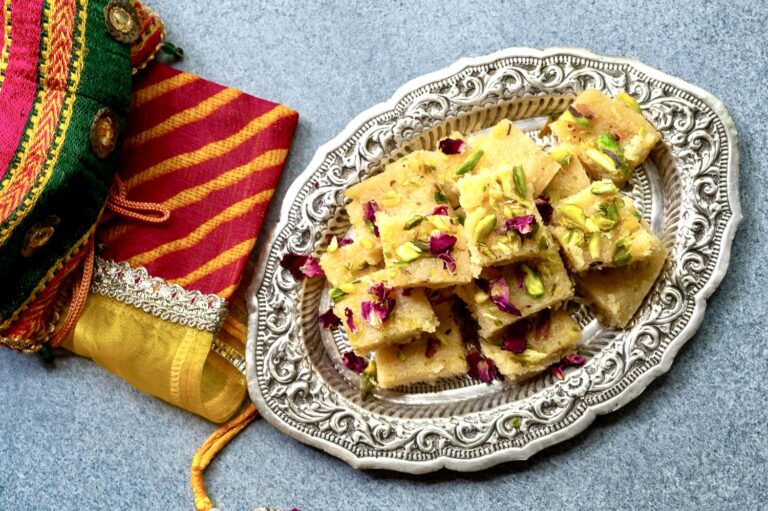
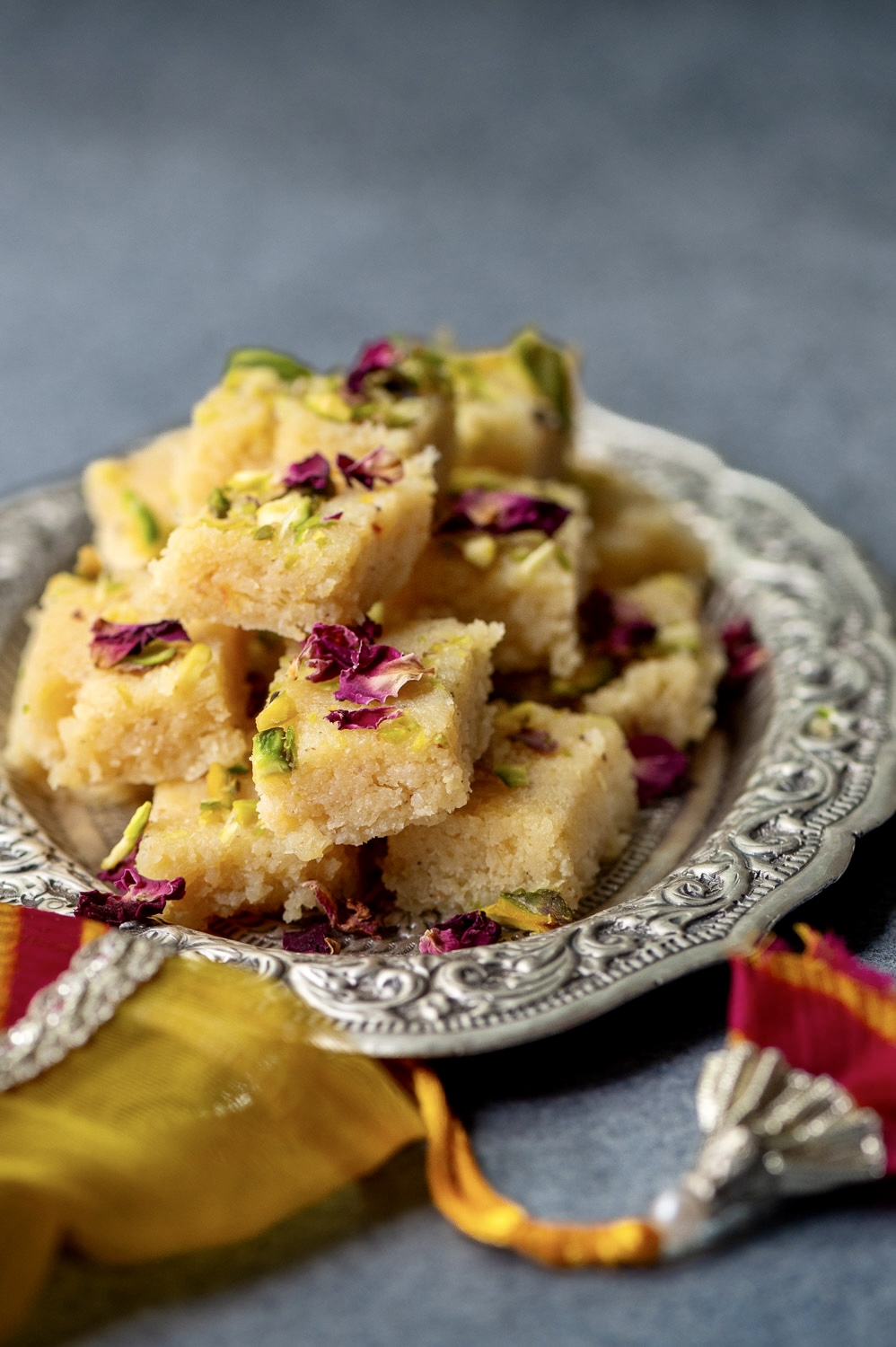
Over the years, I have shared recipes for special treats for Diwali. These include desserts from the Gujarati kitchen such as laapsi and ghugra. Joining these is kopra pak, a lovely sweet that is exquisite in both its taste and its simplicity.

When kopra pak occurred to me as this year’s Diwali recipe, I thought about how it is a dish that is often taken for granted. It utilises just a few basic ingredients, with the ubiquitous coconut as the core. “Pak” means “sugar syrup”, which preserves the sweet and makes it travel well.

As with all staples, there are many versions. Some use condensed milk rather than milk, which is a more modern take on a traditional recipe. Others use sugar syrup, not sugar, or else jaggery. Which ingredient is chosen has an impact on the softness or solidity of the dish. Those using jaggery set differently, and have their own flavour and texture. Hardened kopra paak becomes a kind of coconut candy, whereas the softer kind is naturally easier to cut and to shape. A version with jaggery is prepared for Ganesh Chathurti, and stuffed inside a rice flour modak (a dumpling that is offered to the deity during this festival). I love that one, and desperately wait for those treats at that time of year, which a friend of mine obliges me with.

Here, this kopra pak is for our Diwali celebrations – and hopefully yours as well, not only this year but for many years to still come. While sweets are always a part of our festivities, in our home, my health-conscious side and the fact that my husband is not a huge fan of desserts mean that we aren’t extravagant in our consumption of them. However, kopra pak happens to be one of the rare sweets that he really enjoys. And between watching our erratic cholesterol and BP readings, and still giving an occasion like Diwali its due, I decided that this is going to be the only sweet that I prepare at home this year. How lucky we are that it is so very delicious, and gives us just the right amount of indulgence, without immoderation.

As I prepared it, with excitement, my mind filled with memories of many festivities past. In my childhood, it felt like literally every other family we knew made kopra pak, or some version of it. Coconut is pan-Indian, and so is the concept of exchanging mithais or sweets during special occasions. Whether making a selection, or making just one type, it’s the thought that matters, and the love that is conveyed in the process.

Here, I have chosen to add a dash of rose to this traditional Gujarati sweet. It happens to be a signature flavour at re:store, and I offer this recipe to you with much gratitude for your support and recognition of my work.

This is my ninth Diwali as the creator of this blog, and if you have been with me all this while, it has truly been a journey. One of learnings, growth and change, all driven by my heart’s calling toward food and its intricate relationships with love, culture and life itself. I want to take this moment to share that I will be winding down my regular posting on this blog by the end of this year, in order to focus on a large project that has been close to my heart for a long time. That is, as you may have guessed – and if you are among my dear well-wishers, may even have enquired about – a book.

Kopra Pak With Rose
(Yield: 10-12 pieces)

1½ cups coconut (grated)
¾ cup whole milk
¾ cup sugar
A pinch of saffron in 1 tablespoon milk
¼ teaspoon cardamom powder
¼ cup pistachio (finely sliced)
½ teaspoon rose water
Ghee for greasing a plate

Heat a kadai and add the milk and coconut. Allow to cook on a low flame, stirring continuously. Make sure it does not stick at the bottom. Continue to stir until the milk has almost evaporated.

Now, add the sugar. Allow to cook. Keep stirring.

Once the mixture thickens, add the cardamom powder, saffron and rose water. Skip the rose water if you prefer not to have that flavour in your kopra pak.

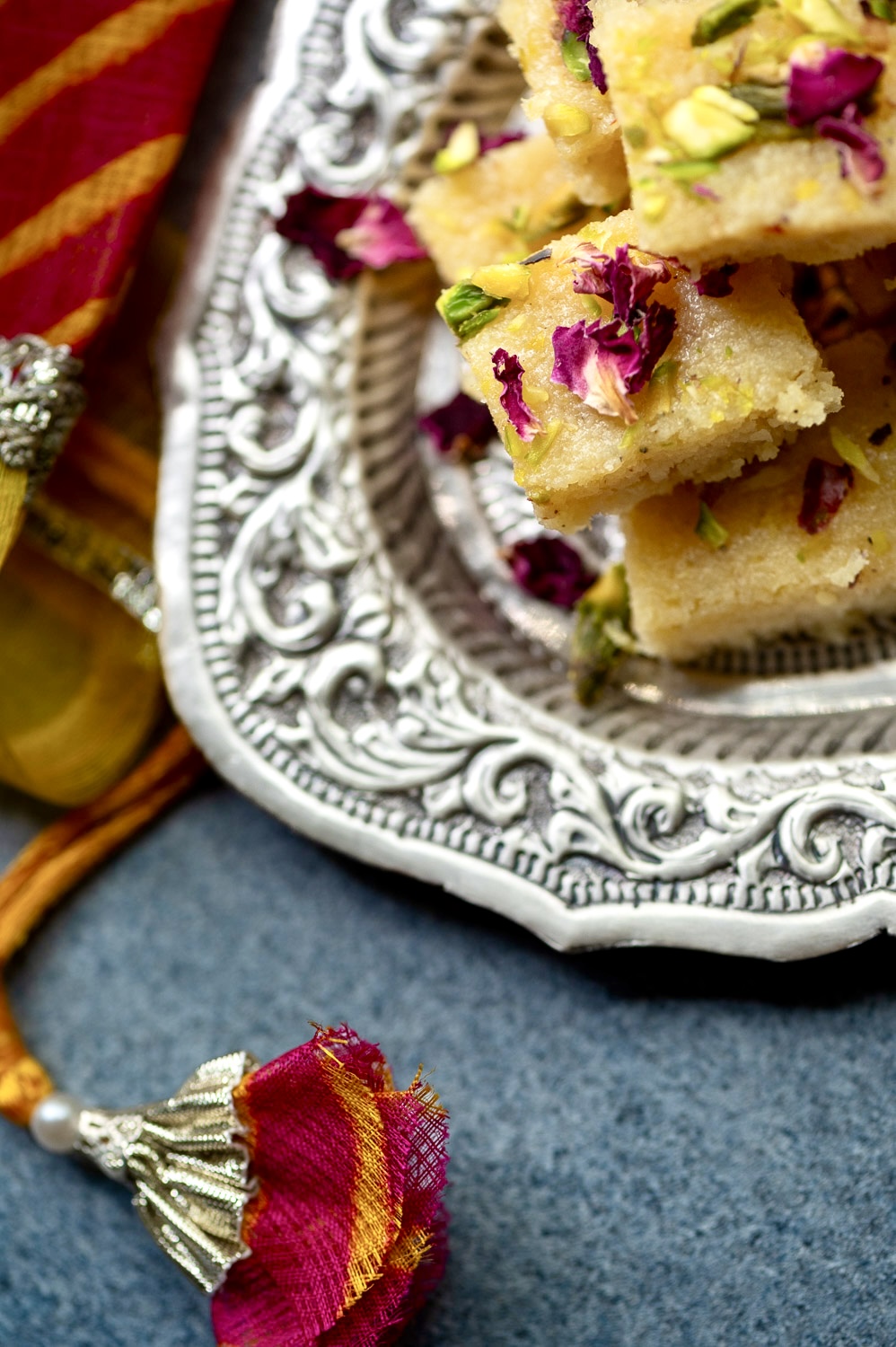
Allow to cool slightly, then transfer onto the greased plate. Flatten with the help of a cup until it looks flat and smooth. Sprinkle with sliced pistachios. You may also wish to garnish with rose petals.

Refrigerate for an hour or until it sets well.

With the help of a sharp knife, cut the kopra pak into the desired shape.

As I said earlier, the gifting of sweets during Diwali is a tradition that conveys love. To me, that is what recording these precious recipes has always been about. I hope that they bring joy to you, and to all whom you share them with!

The cultures around us always have a huge influence on us especially while we are growing up, and this influence often remains through life. Certain recipes and food habits are the most common evidence of this influence, in my opinion. As a Gujarati who was born and brought up in Chennai, Tamil cuisine is obviously one I have immersed myself in, just as much as my native one. Additionally, with a Sindhi member of the family and numerous Sindhi friends, Sindhi cuisine is another one I have an abiding love for. This recipe – a vegetable curry known as sai bhaji – is from the same.

Sindhis are a community who are mostly originally from the Sindh region of Pakistan. The majority of Indian Sindhis are believed to have migrated from there during Partition, a highly significant event in subcontinental history. Subsequently, they also moved to many other countries, and are known – in addition to delicious food – for being very enterprising. It is often said that a Sindhi-owned company can be found no matter where you travel in the world, such is the community known for its business acumen.

My exposure to Sindhi food began in childhood, as I mentioned, through a friend who now lives in Mumbai. Whenever I visit her, she asks me what I would like to eat, and I will invariably request sai bhaji. It is a dish that I recall fondly not just from ordinary meals at her house, but even from birthday parties and such. Back then, these parties were always in homes, and featured homemade food. The only special or exotic thing would be a cake, while even the other treats would all be items prepared by the family. In India, proper food is served at every such gathering, as feeding guests well is a valuable tenet of our culture. A sai bhaji – a healthy item! – would certainly not be out of place.

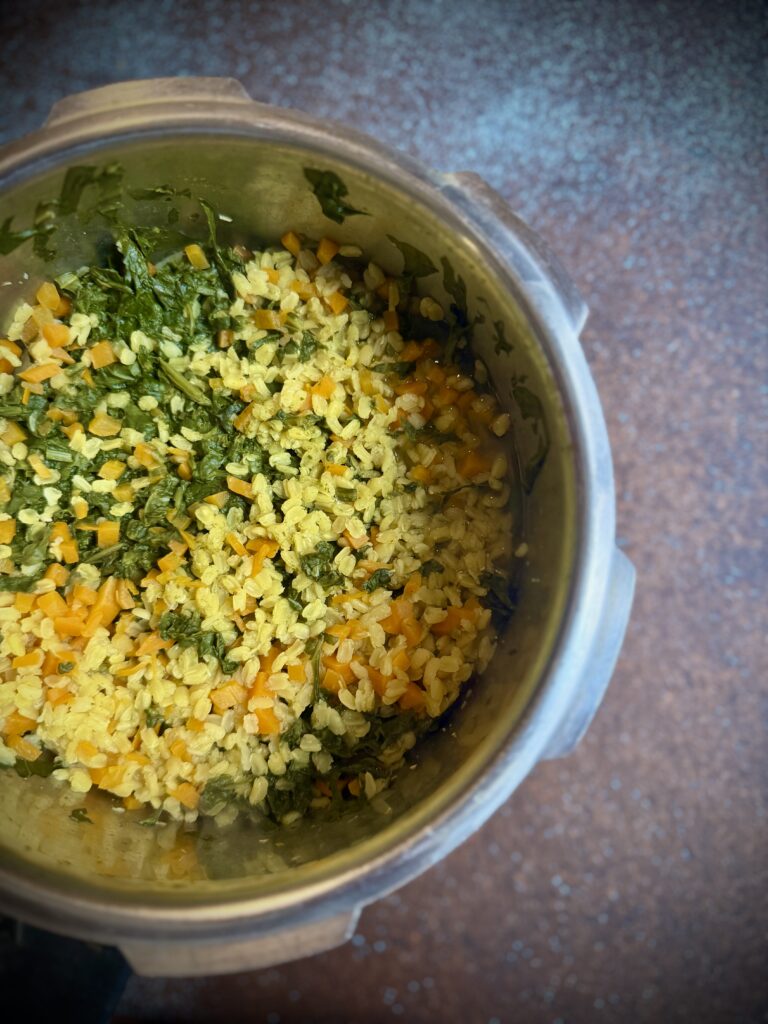
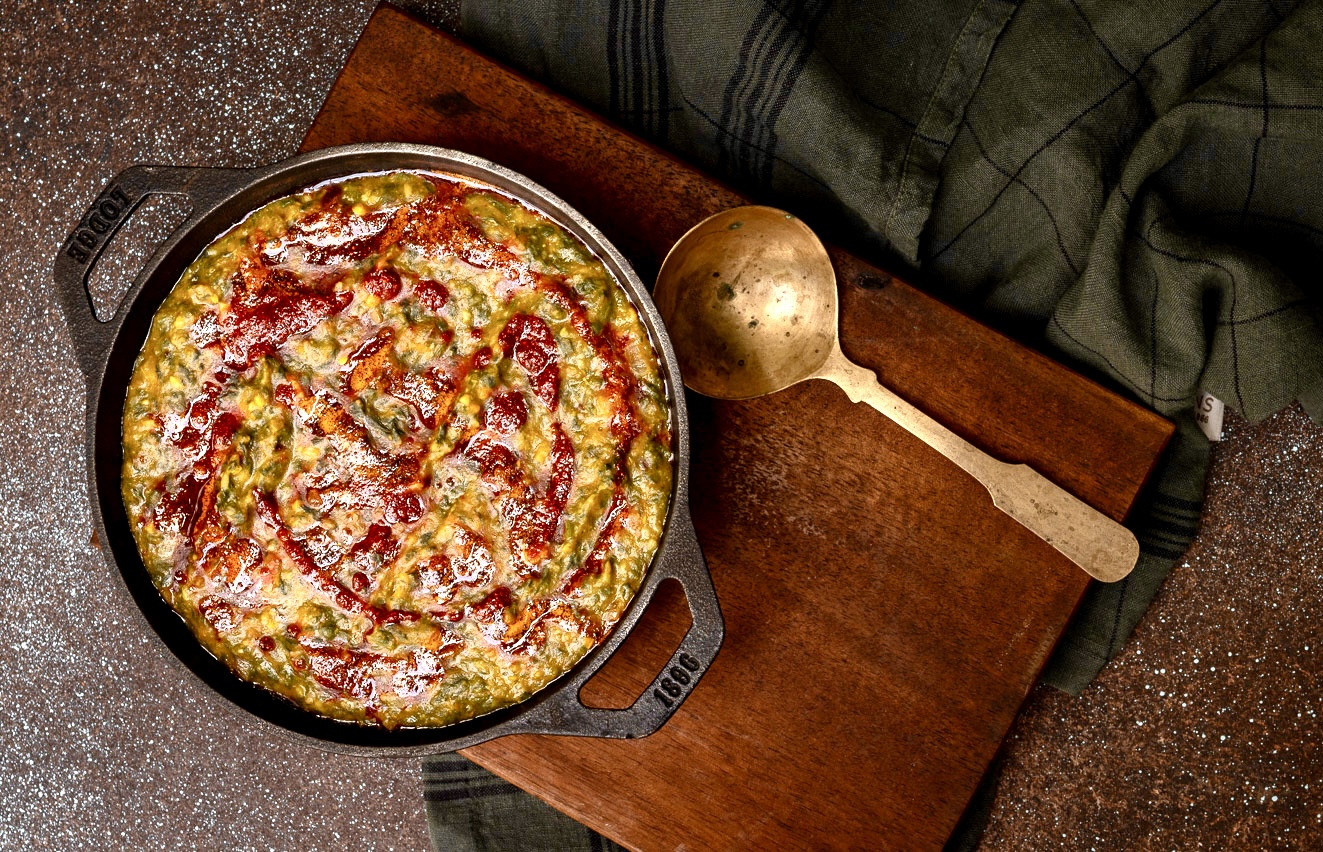
“Sai” means “green” and “bhaji” means vegetables. The dish is spinach-based, and also contains a variety of leftover ingredients. A little leftover brinjal, a little leftover carrot… All these will be pressure cooked along with dal in order to prepare this nourishing dish.

When I said earlier that feeding guests a hearty meal is a part of Indian culture, across all communities, I was thinking specifically of how this is a collective choice in spite of a history of droughts, famines and lack of economic power. Perhaps because of this history, we are very cautious about not wasting food and use leftovers very sensibly. Some years ago, I did a series called “Second Helpings” of traditional recipes that innovate using leftovers. We turn around every little bit that sits in the fridge, and have done so since well before the invention of fridges, in fact!

To me, how we treat food and how we treat knowledge are the real wealth of India. We hold both in such regard, because the fact is that many generations have had to do with less of both or either than they deserved. To us, throwing food into a bin is as much of a sin as stepping on a book or a newspaper. The respect we have for such objects, the respect we have for guests: we know what is precious, whether or not that preciousness is measurable on material terms.

Sai Bhaji
(Yield: Serves 4)

1 medium-sized onion
1 medium-sized tomato
1 tablespoon ginger (grated)
1 teaspoon garlic (grated)
1 green chilli
1 bunch spinach (palak)
3 tablespoons yellow moong dal
1 medium-sized potato
1 medium-sized carrot
Any vegetables of your choice
2 tablespoons oil
Salt to taste
½ teaspoon turmeric powder
1 teaspoon chili powder
1½ teaspoons coriander powder
½ teaspoon cumin powder
2 tablespoons water

In a pressure cooker, place the dal followed by the vegetables and finally the spinach. Add 2 tablespoons of water and allow to cook or whistle until tender.

Meanwhile, chop the onion and tomato.

Heat a kadai, add the oil. Then, add the onion, garlic and ginger. Finally, add green chilli and sauté everything until golden.

Next, add the chopped tomato. Sauté and add all the spices. Stir well.

Open the pressure cooker and mash all the vegetables until they come together.

Finally, add the vegetables to the onion-tomato mixture and mix well.

Add a dash of water if you prefer it to be less thick.

Your sai bhaji is ready. I enjoy eating it alongside hot rice, with kadhi and curd on the side. I hope you’ll enjoy this lovely recipe from Sindhi cuisine. I am sure you will find, as I do, that it pairs beautifully with other dishes from across the Indian subcontinent.

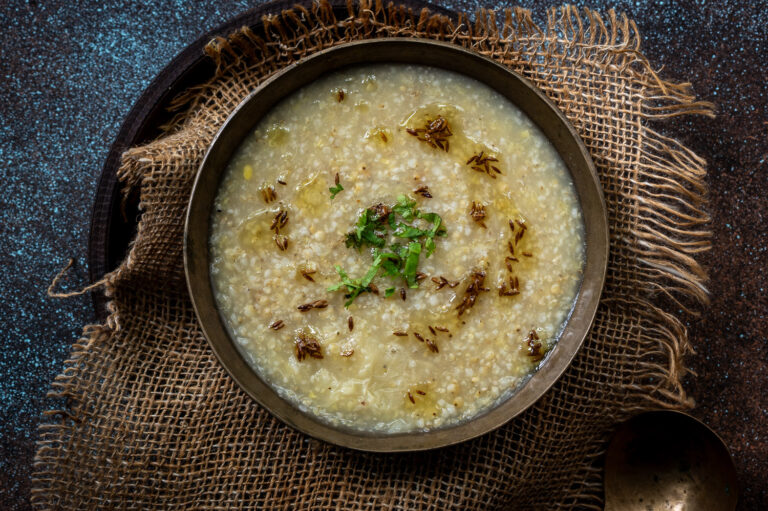
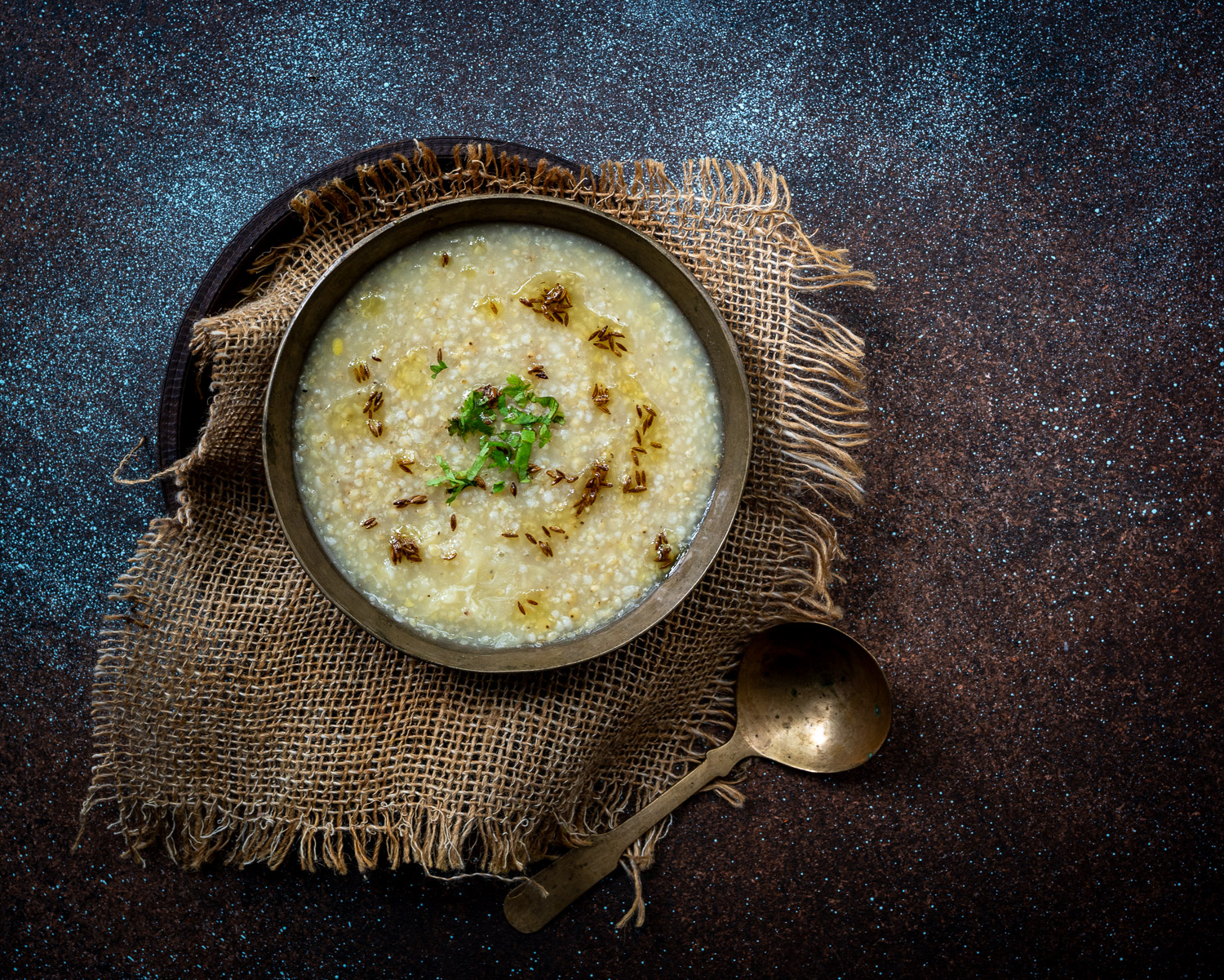
Millets have made numerous appearances on this blog. They were, traditionally speaking, widely consumed across India and have in recent years made a comeback among the health-conscious. When it comes to jowar (which you may know as sorghum), the fibre, protein and essential minerals it provides – along with the fact that it is relatively light to digest – make it an excellent choice. This jowar khichdi is a great dish to put a little energy boost into your day, and is ideal for either lunch or dinner.

In the last post, I shared the recipe for jowar roti. I had said then that the winter variant of jowar roti is bajra roti, which uses the heavier pearl millet. It is important to note that millets are not universally interchangeable. A jowar dish made for breakfast, such as for example a jowar upma, cannot become a bajra dish through mere substitution. Bajra tends to be heavier on the stomach and takes more effort to chew. One does not want to tax the system so early in the day. If at all I want to have bajra in the mornings, I will have it in roti form.

That said, you can certainly use some other millets in lieu of jowar in this khichdi form. The method will remain the same, but the cooking and soaking time (if required), will vary. A millet with smaller grains, such as little millet or foxtail millet, will cook faster and without pressure cooking. Jowar, on the other hand, benefits from a few hours of soaking. Keep these factors in mind whenever you select a millet, for any kind of dish.

When my children were younger, millets weren’t part of our regular meals. We weren’t familiar with them, and there was hesitation around the unfamiliar taste and texture. I myself only started experimenting with them a little over a decade ago. At this point, the entire family also began to enjoy them. Since then, I’ve been a strong advocate for incorporating millets into daily meals. Each kind satisfies certain nutritional requirements, and has its own taste. As with any grain, flavour pairings also make a difference. For instance: jowar is known for a subtle, slightly sweet taste, while little millet has a hint of nuttiness. My recommendation is to keep experimenting in the kitchen, always. Even when working with very traditional recipes, the learning never has to stop.

Jowar Khichdi
(Yield: Serves 2)

1 cup coarsely ground jowar
Water as required for soaking
2 cups water (for cooking)
Salt to taste
1 tablespoon ghee
½ teaspoon cumin seeds

Soak the jowar for 6-10 hours. Rinse well.

In a pressure cooker, add the soaked and rinsed jowar along with water and salt.

Cover and cook for 4 whistles. Allow to cool, then open the lid.

Heat a small tempering bowl. Add ghee and then cumin seeds. Once the seeds splutter, pour the tempering over the khichdi. Serve immediately.

Hot khichdi is a comfort food that has had other iterations on this blog, and I’m glad to share this one with you too. I hope this jowar khichdi becomes one of your preferred variants too.

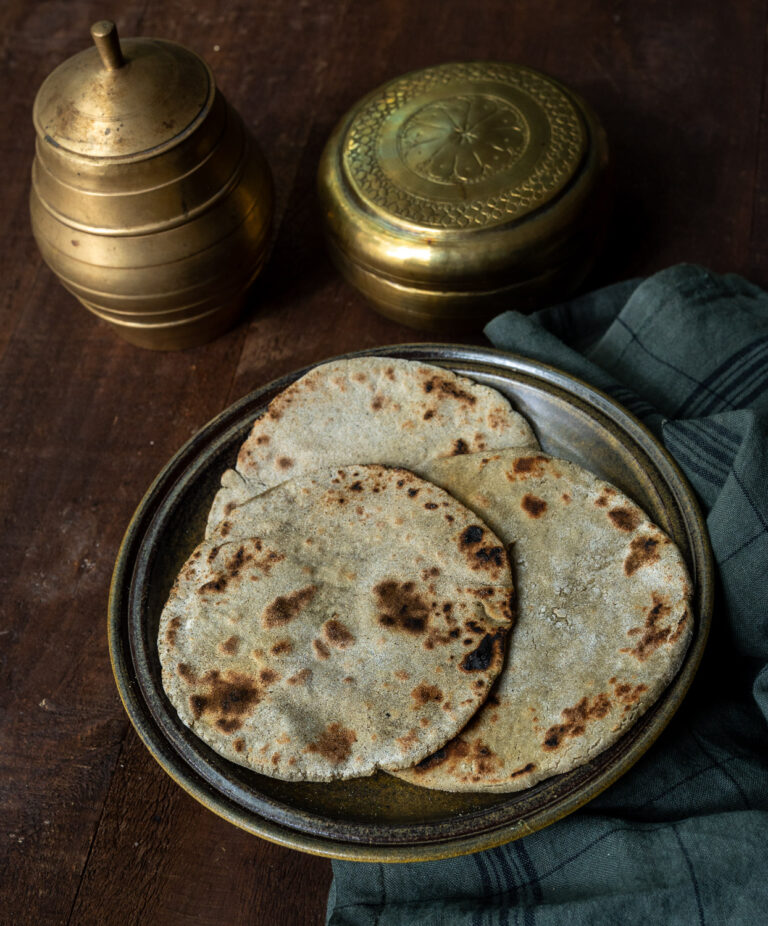
Time and again, I have spoken on this blog about how eating seasonal produce is the best thing for our bodies. We are a part of Nature, and it is intrinsic in us. We cannot look at it from the outside, or even objectively, because we belong to it. We cannot go against its flow, which is what we often try to do today. However, I believe that even as the world changes and decentres Nature, in our own lives we can actively choose – at the very least – to listen to our bodies. When we do, we will quickly realise that our hunger cravings have a rhythm with climatic cycles. Here in India, while the peak of summer is behind us, the winter is still far enough away that lighter grains are what we need. Hence, jowar (known in English as sorghum) is something I am making meals from these days. This jowar roti is an excellent use of the same, incorporating the ingredient into a daily staple.

I am fortunate to have access to very good quality, homemade jowar flour through my sister. She has a small mill in her kitchen, which she uses to prepare her own flours and powders. I have observed many other households in Mumbai doing the same. When I visited her recently, she was making jowar flour. What intrigued me was that she added a handful of soyabeans to it. I found this an interesting, and very healthy, combination. I don’t have a mill of my own back in Chennai yet, but as I teased my sister, I don’t need to, as I can just keep asking her for homemade flours. She gave me a kilo of jowar flour on that visit, and it’s being used liberally – and I’ll soon need more, as I’ve already warned her!

If jowar is used in warmer months, it is bajra (known in English as pearl millet) that is preferred in winters. Jowar is not only lighter on the digestion, but in flour form also easier to fold into roti dough. It really is so simple to make, requiring no pre-prep. All you do is add warm water, which brings out a glutinous consistency, then make the dough and roll it out immediately in order to fry it up. Bajra flour, on the other hand, tends to break apart as you roll it out due to a complete lack of gluten.

Both jowar and bajra rotis are eaten in my home. Depending on the season, one or the other will be served at lunch – except during the height of summer, when rice replaces roti altogether. Other than during that time, these two are staples, even though a wide variety of other flatbreads are brought into our meals too. I have been rolling out rotis since I was a young girl, and am able to handle different flours, but it does take practice. The trick is in the hand, and in being patient.

Jowar roti, despite being made of a lighter flour, is very filling. Just one piece, with a cup of dal or two cups of vegetables, is a perfect lunch. You don’t need anything else for hours after.

This may be why my mother would have some jowar roti during days on which she performed certain kinds of fasts, for instance. I am not entirely sure because the truth is that I paid very little attention to some of the items that my parents ate when I was a kid, and jowar roti was one of them. My siblings and I would screw up our noses when we saw it, so our mother always prepared regular whole wheat rotis for us instead of these healthier ones. I regret not having eaten jowar roti back then, but I am grateful that I learned how to make it.

Exposure plays such an important role in what we reach out to – or return to – in terms of food as we grow older. What we saw being prepared or consumed as children, whether we appreciated it or not, stays with us and informs our choices later on. Sometimes, I think about whether my kids – now grown and with homes of their own – will ask for these recipes when they have children of their own, whom they will of course want to provide the best of everything to. That is one of the core reasons behind this blog: it is my legacy to my loved ones, just as much as it is my offering to anyone in the world who seeks the comfort of a well-made meal.

Jowar Roti
(Yield: 3 pieces)

1 cup jowar flour

1/2 cup water

A pinch of salt

In a bowl, add the flour. To this, add water and salt. Mix all the ingredients with your fingertips and massage well, binding them all together. Make 3 balls of the dough and set aside.

Using your palms, roll out the balls. Sprinkle some flour onto the rolling board, and add some flour on top of each ball as well. Gently roll out the balls into flat discs. 

Heat a roti pan and add 1 disc at a time. If the roti is thick, then keep your flame on low or medium and cook the roti on both sides.

Now, with the help of tongs, place the roti on the stove or directly on the flame and allow to cook until spots appear. Set aside.

Repeat with the remaining balls.

Serve with hot ghee and/or along with subzi or pickle.

Stay tuned for another jowar-based recipe that I’ll share here soon. You may also wish to explore other millet dishes that I’ve shared over the years.

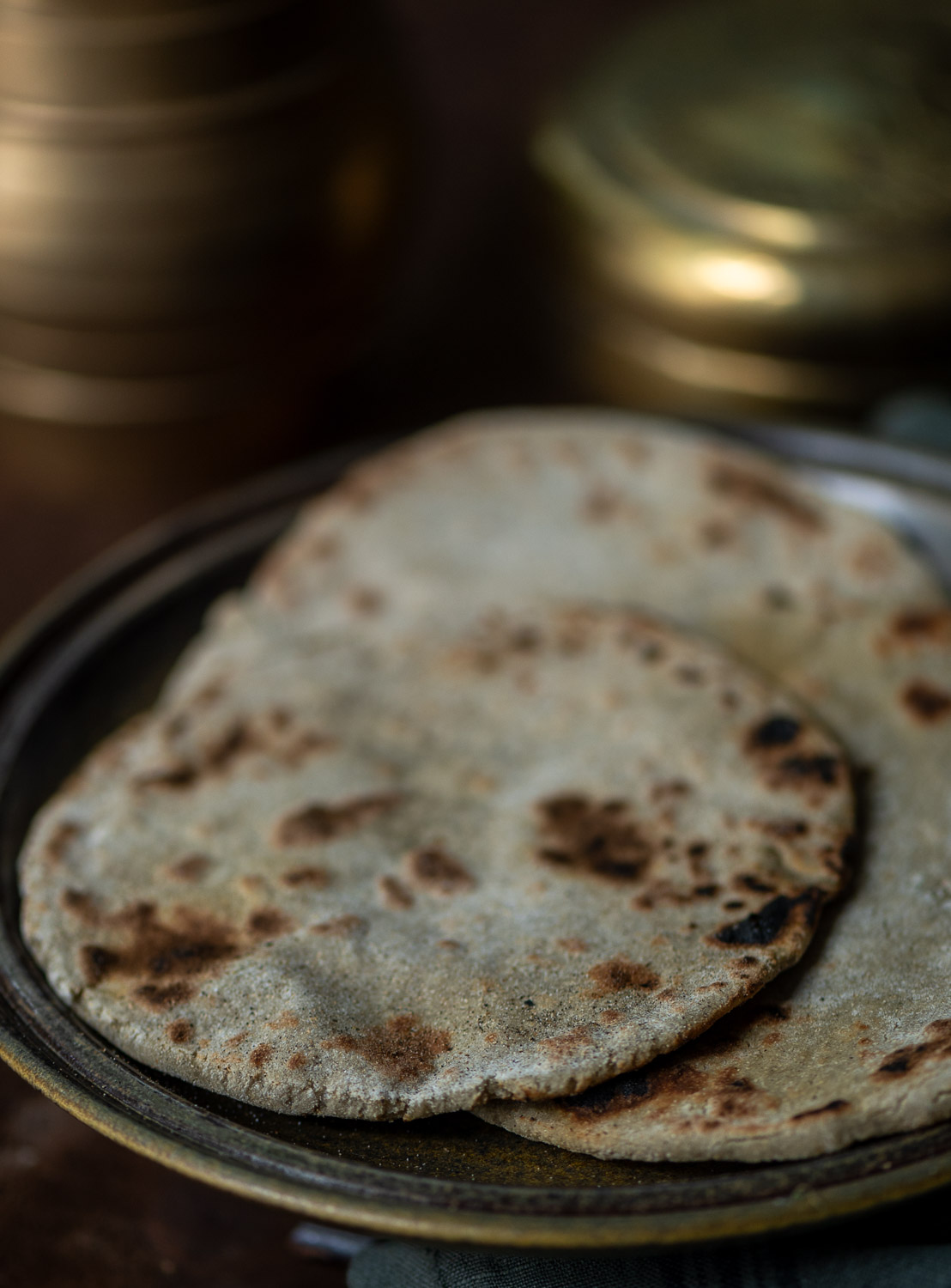
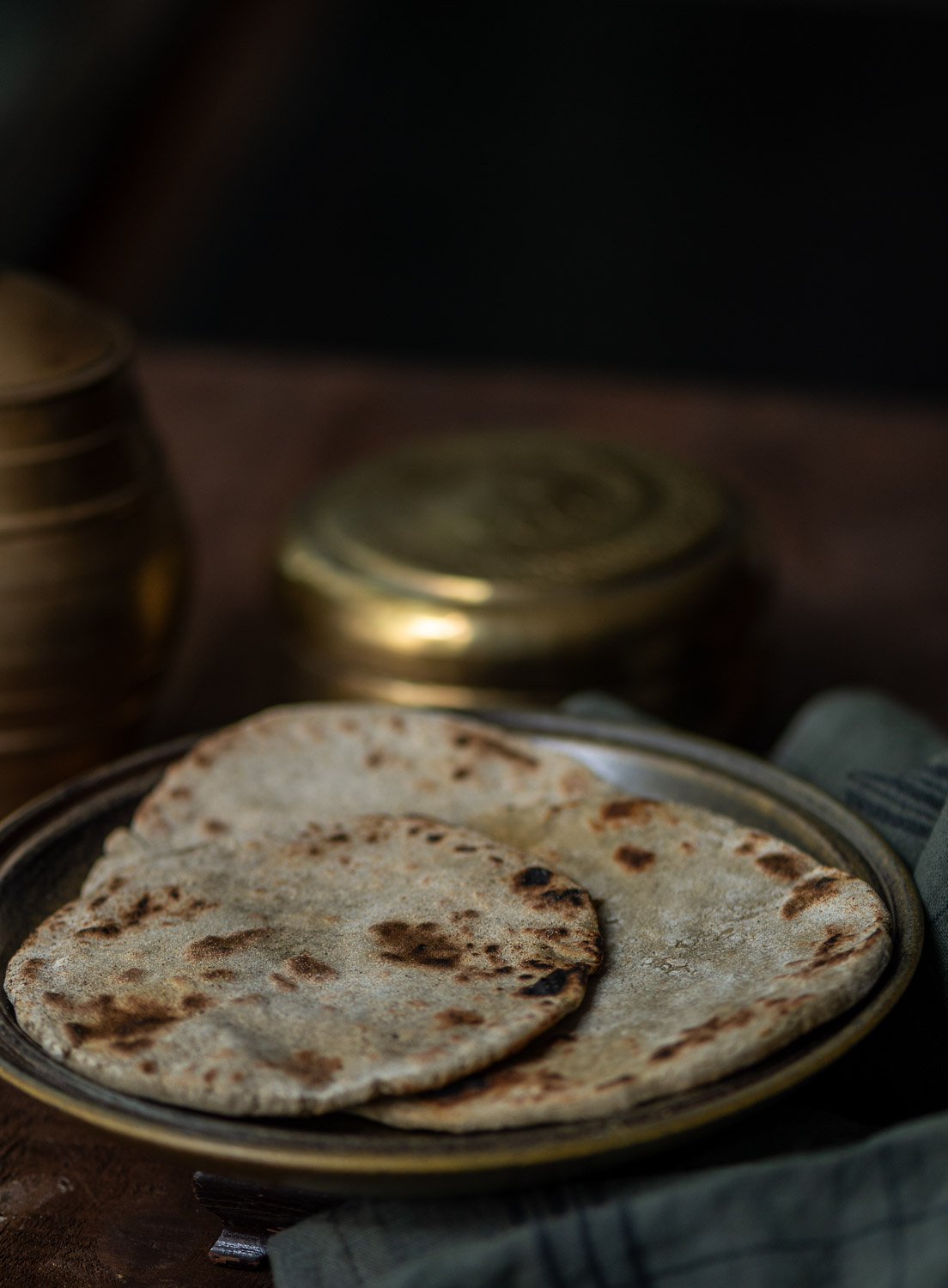
There have been many paneer recipes on this blog over the years, including most recently a lunchbox-friendly paneer tikka roll. The ingredient is a reliable staple for most Indian vegetarians, maybe even more deliberately so now that the importance of consuming protein has been understood by more people. However, I feel it has long been cherished, even before modern health-consciousness, as it is a dairy product. Hindu culture considers milk to be holy. It is offered to the gods and is valued almost as a kind of nectar from the heavens, which is why the cow is also sacred, being the creature that provides it. Today, I’m sharing my recipe for homemade paneer. It is a quick, convenient and simple method to ensure a regular, high-quality supply of an ingredient that you may already be eating a lot of.

It is of course exceedingly easy to just buy paneer. There are decent brands available, and your nearest organic market will also offer choices beyond the commercial ones. I used to rely on the same, but in more recent years the number of adulteration issues in Indian products has made me become even more cautious about what I purchase – because it becomes what I prepare, and what my body processes. With loved ones to feed, the concern is all the more. To me, it comes down to this: just make sure your source is a reliable one, when it comes to any ingredient. If you have the time and inclination to make something at home, do. Or else, just be discerning about what you reach for at the store.

My son who lives abroad uses store-bought paneer in his Indian meals. I am happy that he still enjoys and wants to prepare dishes that he grew up on. This recipe for homemade paneer is especially for him, to encourage his next steps in his culinary journey.

I hope it will be the same for you. As mentioned earlier, I have found that this is the most trouble-free method for making paneer frequently. In terms of contraptions, there are many paneer-making boxes available nowadays, but I use a simple muslin cloth, as is traditional. You must find a method that works for you. When it comes to certain ingredients or dishes, I believe that anyone who really wants to make some will find a way. Paneer is one of them, for sure. It’s a question of whether you feel the effort is worth it, even if it’s fairly easy. Where there’s a will, there’s a “whey”, shall we say!

Speaking of whey, I ensure that I gather the whey that is a byproduct of this process and do not throw it away. I add it to dal or else to atta to make rotis, which will subsequently be paired with a paneer dish. Whey is a form of protein, and doesn’t have a flavour in itself, which means it can be added to a number of dishes easily to boost their nutritional quotient. It could even go into a soup, for instance. Depending on what else I am making in the kitchen that day, I will make sure I use it up. There’s no wastage when you make paneer. You can also soak it in water and keep it in the fridge for up to four or five days, which means that it’s very unlikely that you’ll waste the paneer itself. Who would, really? It’s just too tasty to not finish up!

Homemade Paneer
(Yield: 125 grams)

 ½ litre whole fat milk
Juice of 1 lime OR ½ cup sour curd OR a few drops of vinegar

Equipment
1 strainer
A muslin cloth
1 large bowl

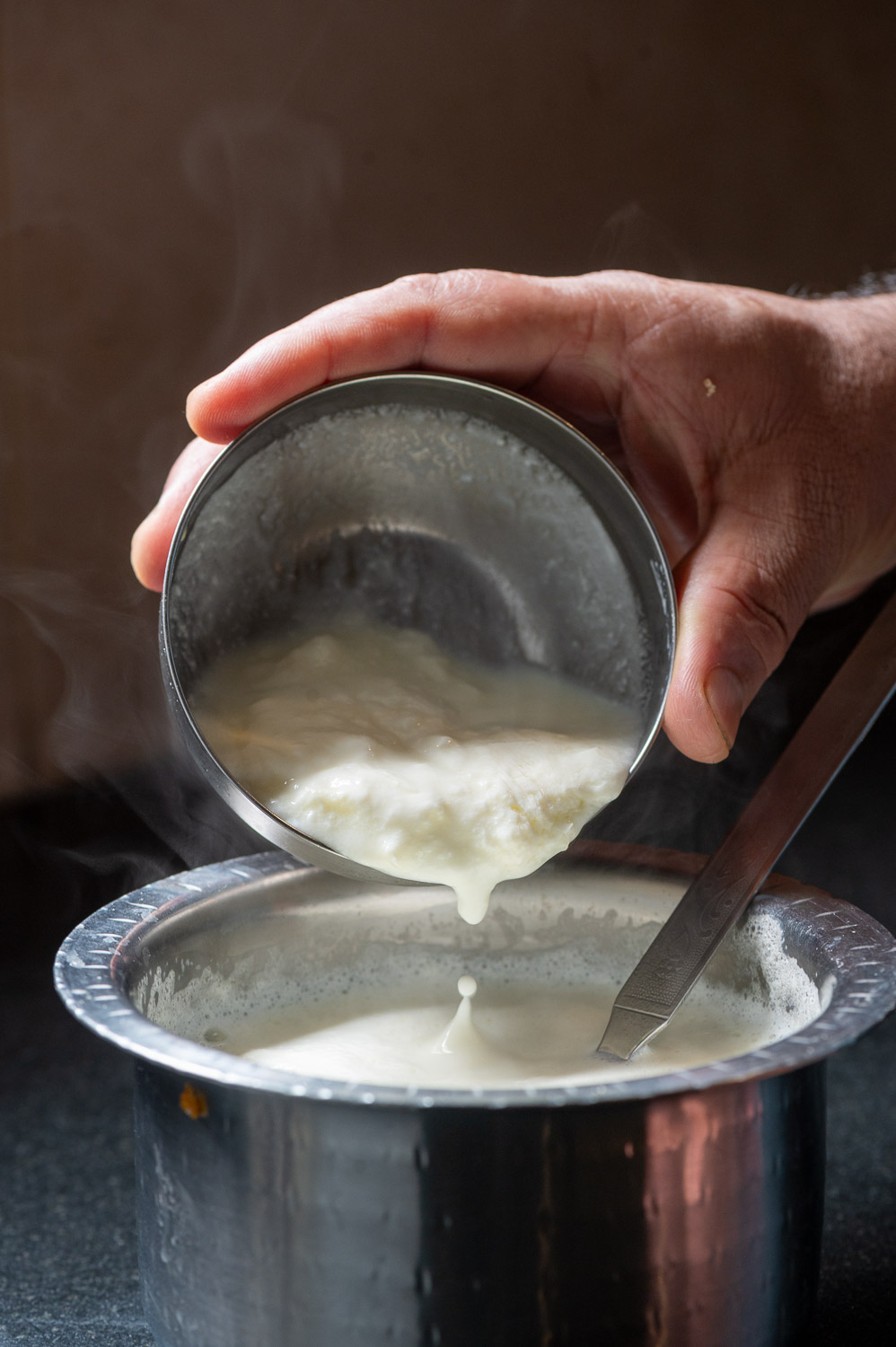
Boil the milk in a pot. Stir occasionally so it does not burn at the bottom.

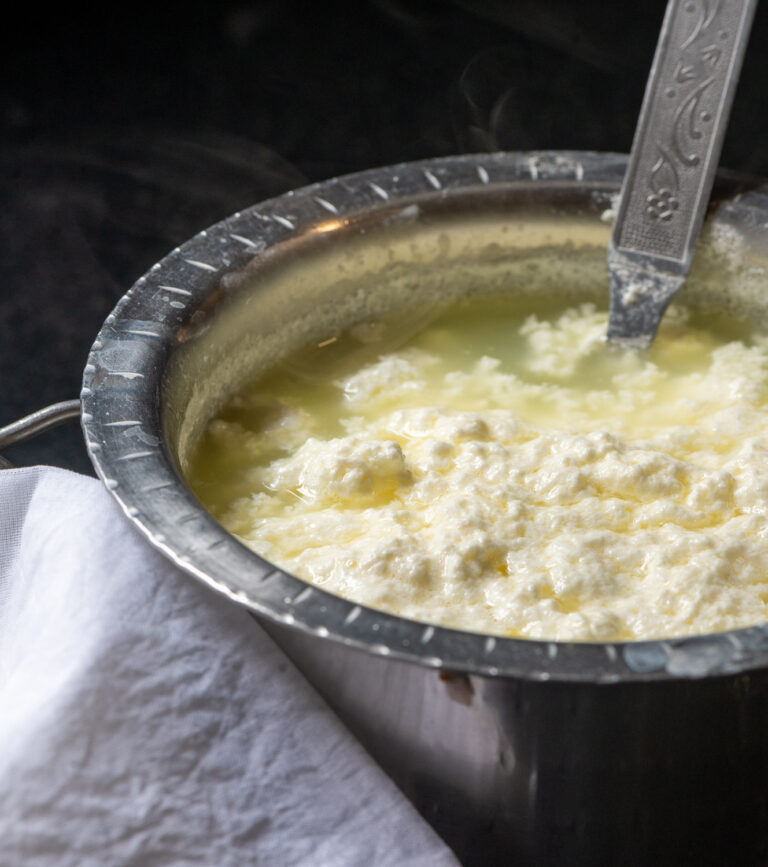
As soon as it is ready to boil, add the curd /lime juice / vinegar. Stir very lightly. You will soon notice the milk will begin curdling.

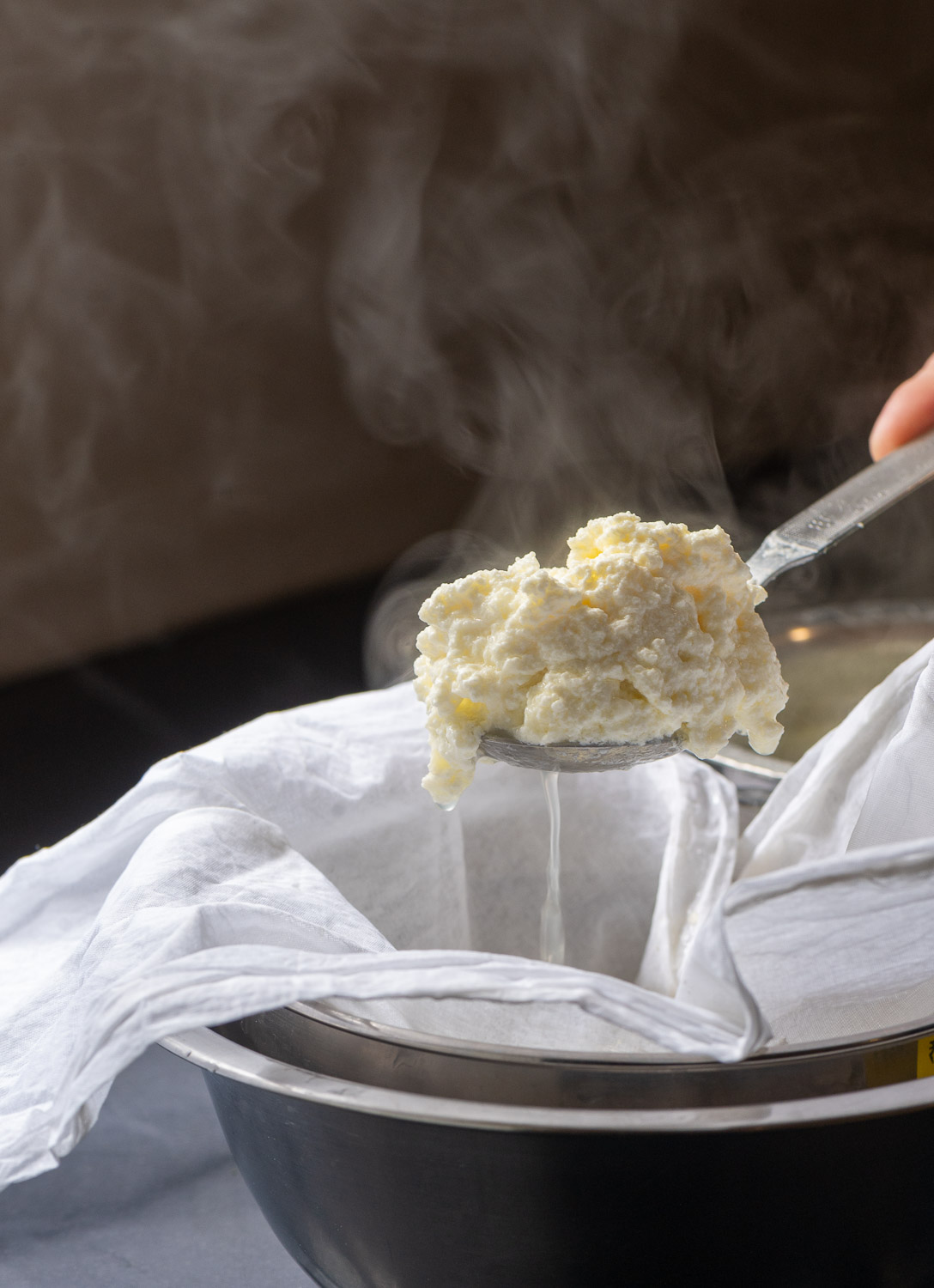
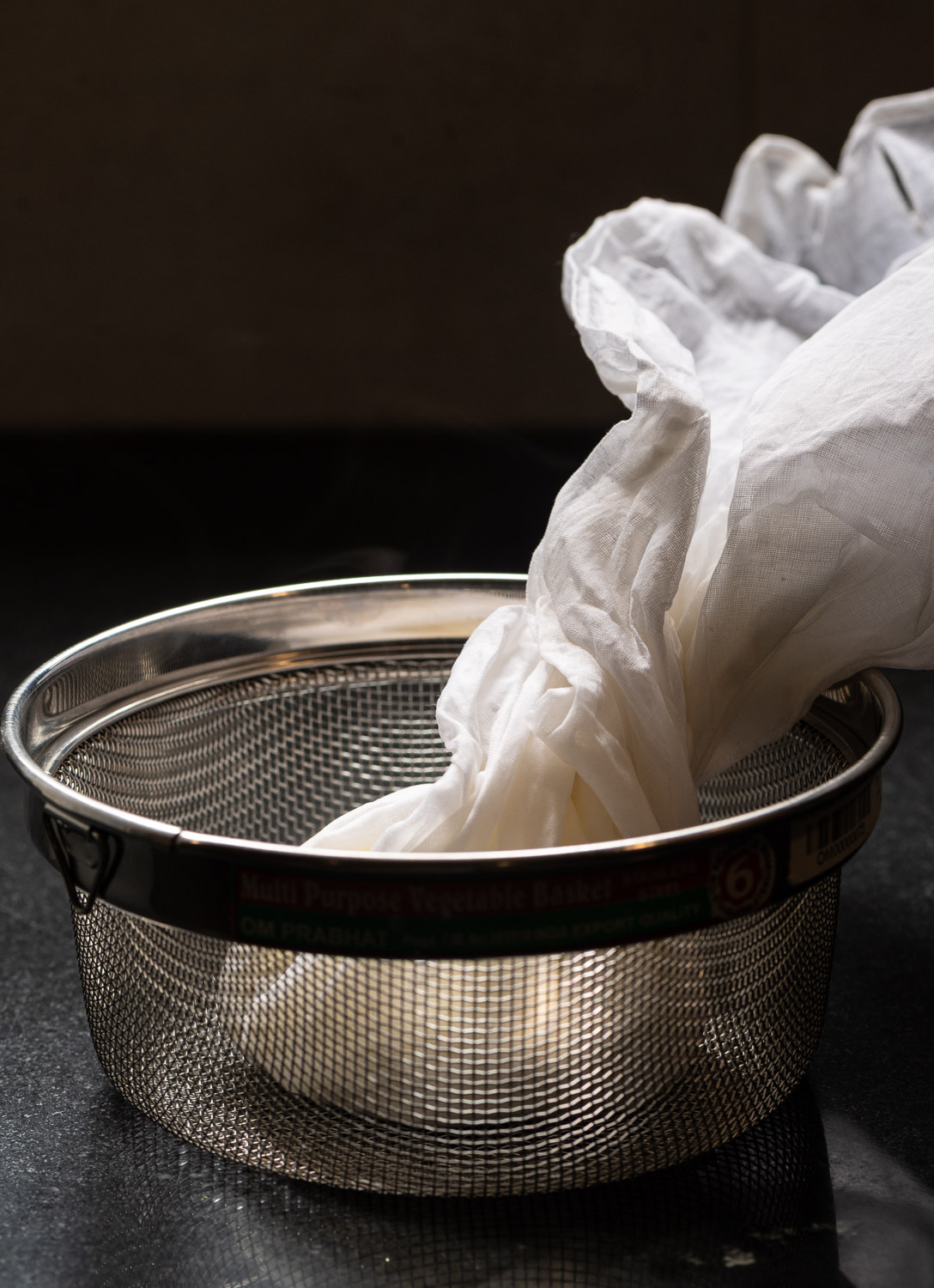
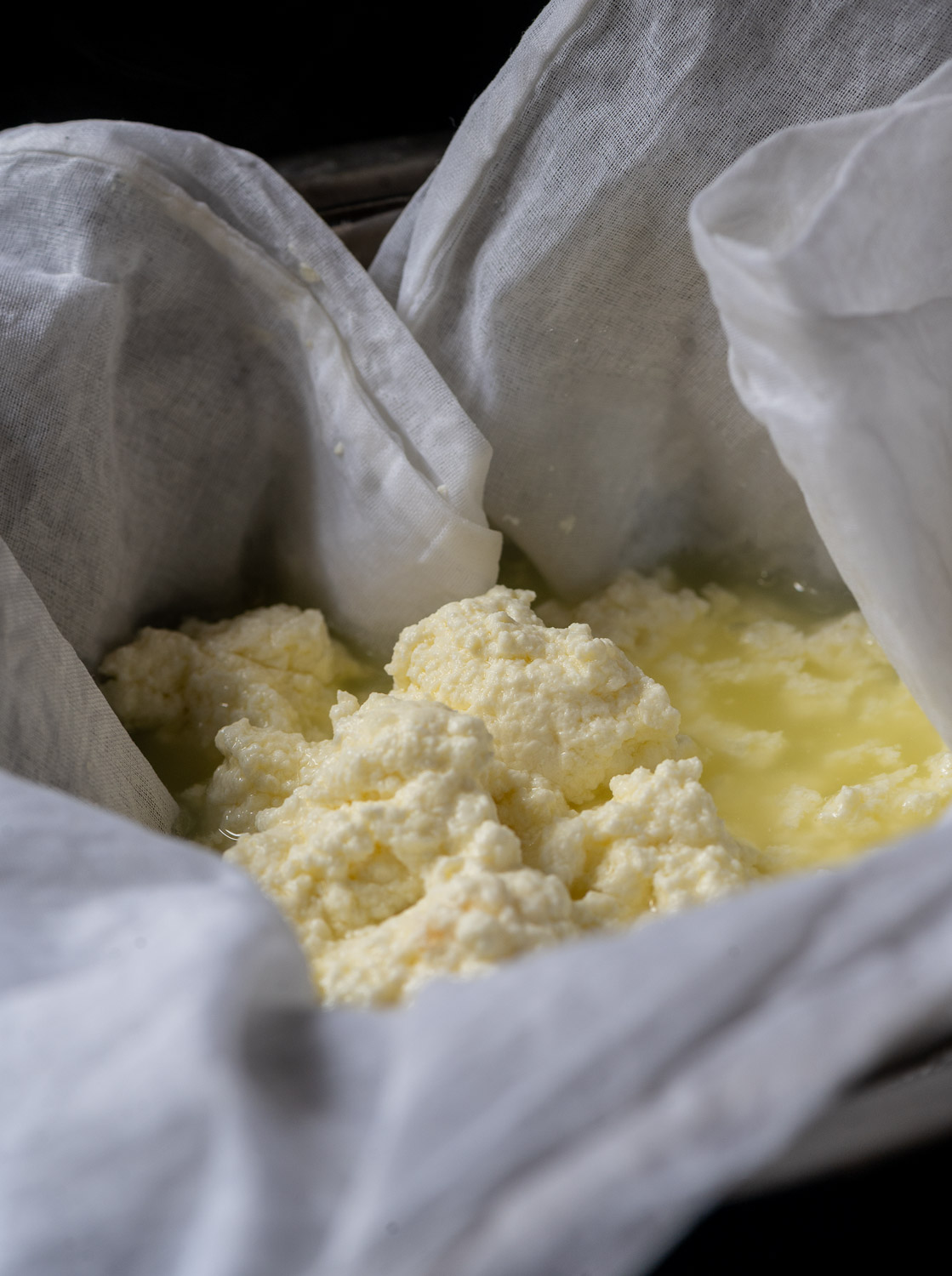
Now, pour the contents through a muslin cloth placed over a strainer and collect the whey at the bottom.

You will notice the whey is not milky but looks yellow. Set aside the whey. You may wish to use it in other dishes, as mentioned earlier in this post.

 Rinse the paneer under cold water for a few seconds. Then, gather the cloth around it and close tightly.

Place this bundle on the strainer. Place a weight over it to set the paneer. Allow to sit this way for about an hour.

After an hour, remove the weight and the cloth. You will see that a beautiful block of paneer is ready to be cooked. If you’re in need of ideas about how to use it, do explore some recipes I have shared before.


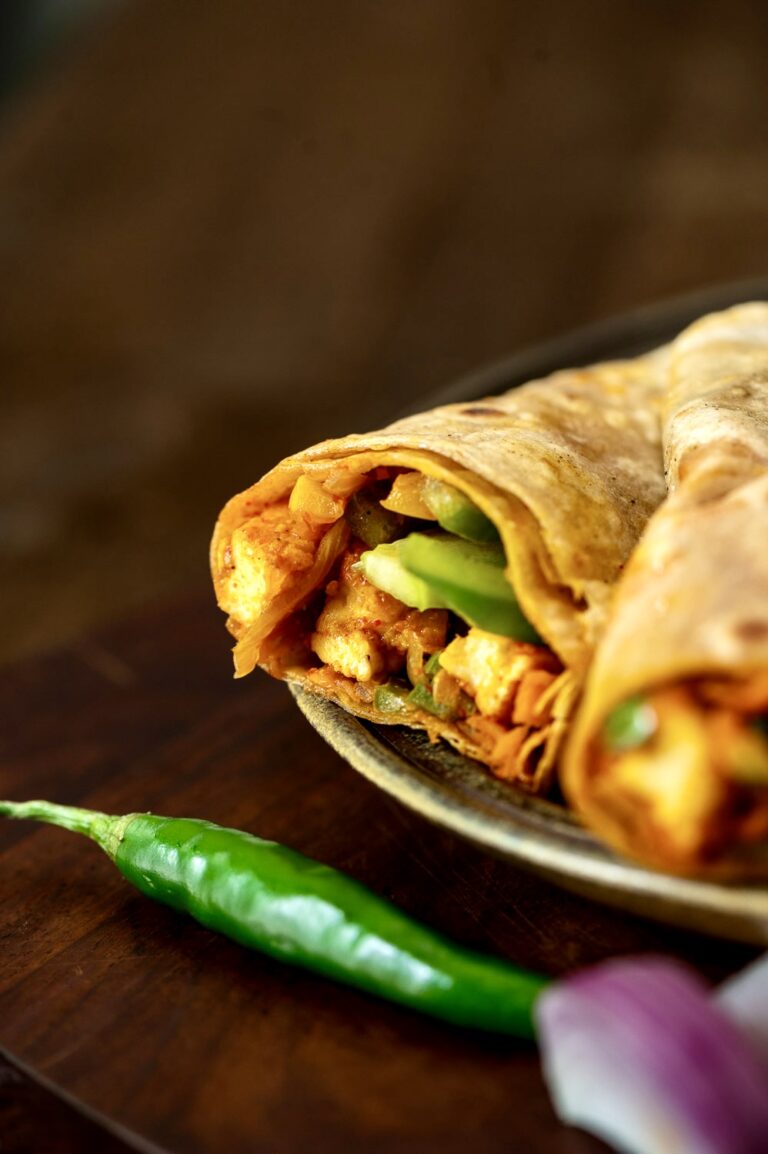
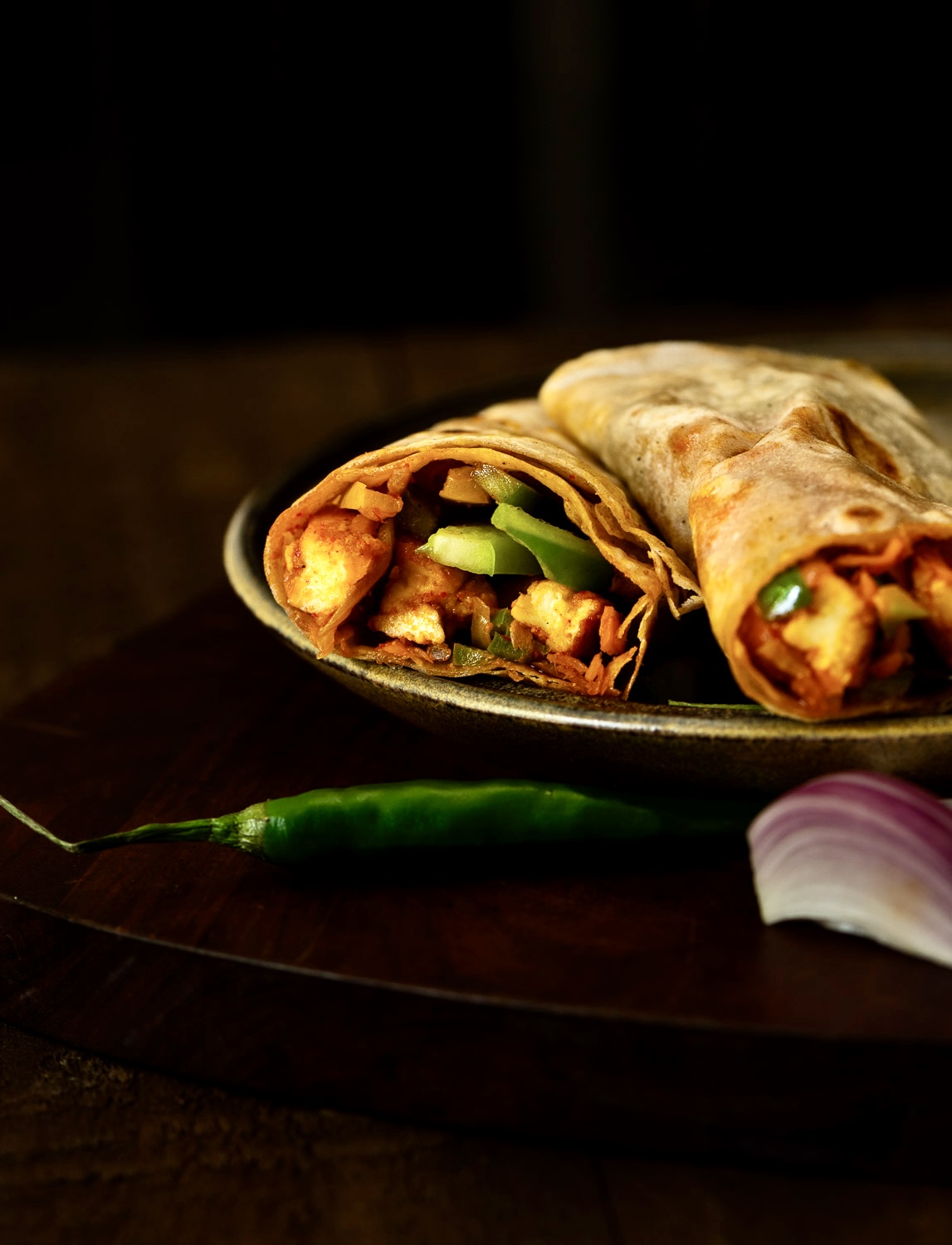
There was a time when I thought that once my children had grown up and had gone away for their higher studies, my job as a preparer and packer of tiffin boxes would come to an end. Clearly not! Now, I still find myself making daily choices regarding healthy lunch options that they can enjoy at the office, and still struggle now and then with figuring out good ones that are tasty, nutritious and can keep well for a few hours. In frequent rotation is this paneer tikka roll, which fulfils all those criteria.

I know that this challenge is one faced by many people around the world – whether they are packing for themselves, or for a loved one who is going to work or to school. My son also requests homemade meals that he can carry on flights, and packing for travel is its own culinary category – wouldn’t you agree? We all want our families to eat well, even when we can’t personally serve them hot food.

I think in my case, my belief that fresh food is always best has sometimes made it all the more difficult for me to accept that anything else quite comes up to the mark. Even after all these decades of practice with tiffin boxes for my children and my spouse, all at different ages and stages of their lives and of mine, it’s a feeling I can’t entirely shake off. I remain practical, however. At night, I ensure my refrigerator is empty of cooked food, but any kind of prep that makes the morning easier is kept ready. The next day will invariably be busy as I rush about preparing something that is both appealing and healthy.

In this case, I marinate the paneer on the previous day and keep other required ingredients handy, so that there will only be minimal cooking and assembling the next day.

While this paneer tikka roll is a smart way to carry a protein-rich packed lunch, it is reminiscent of homemade meals in the sense that it is in some ways a reconstruction of the standard paneer sabzi and roti that in eaten in many homes across India. This is the kind of meal that I always make extra helpings of, because it is appreciated across generations. The roll solution really is genius, I feel. What makes it even better is that it can be stuffed with extra vegetables, making it distinct from street food or store-bought rolls. I like to add colourful bell peppers, which add a crunchy texture.

I must confess that when I prepare paneer tikka for myself, I eat it more like a salad with lots of veggies than in the traditional way. I avoid the roti – i.e. carbs. At other times, I serve it to my aged father alongside rice instead, as this combination is easier for him to consume. You can use the paneer tikka itself in a number of ways, other than in a roll format. You can also replace the paneer itself with tofu or your preferred protein. On that note, I often prepare paneer at home, and will share the recipe for the same in an upcoming post.

Paneer Tikka Roll
(Yield: Serves 1)

100 grams paneer
Salt to taste
¼ teaspoon turmeric powder
½ teaspoon dhaniya (coriander) powder
A pinch of garam masala
½ teaspoon chili powder
¼ teaspoon garlic paste
¼ teaspoon ginger (grated)
1 tablespoon yoghurt
1 teaspoon oil
1 teaspoon ghee
½ cup bell peppers (sliced)
½ cup onions (sliced)
2 big size rotis (for reference see the post here)
Green chutney (optional)

Marinate the paneer in the yoghurt. To this, add chili powder, dhaniya powder, turmeric, salt, garam masala, garlic paste, grated ginger and oil. Allow this to marinate for at least 30 minutes. You can also do so overnight, as mentioned earlier.

Heat a pan and add a teaspoon of ghee. Add bell peppers and onion. To this, add the paneer and cook until it is soft and golden.  Do this on a high flame. Once soft and slightly golden on both sides, remove the paneer onto a plate and set aside.

To assemble the paneer tikka roll, cook the rotis on both sides. Remove them from the griddle and place them flat. Apply green chutney or other condiments, if you would like to.

Place the paneer mixture in a line at the centre of each roti. Fold both sides of the roti over the same. Wrap in parchment paper.

Cut into half and serve fresh, or place into the lunchbox or tiffin carrier to be enjoyed later in the day.

I know there are many lovers of paneer who read this blog, and I hope you’ll explore more paneer-based dishes in the archives!

My son who lives abroad often tells me how much he craves home food, or Indian food in general. As I do for all my children, there are certain special dishes that are prepared without fail during their visits, depending on their individual preferences. This son’s favourite is biryani, which means that I make it very often – and very happily, I might add. So much so that I began to roast and store the masala, or the spice powder, myself too. This biryani masala powder is versatile, and can be used with a wide range of biryani styles.

Biryani is a pan-Indian rice dish invented by the kitchens of the Mughal empire. In its original form, it is basically highly flavourful rice cooked with meat. Across the country, versions and variations of this basic concept – with and without meat, and utilizing different rice grains, particularly short and stout ones like samba or long ones like basmati – have pride of place. I continue to encounter biryanis that are new to me, such as a fish biryani that I had at a friend’s place not long ago, which I had never been aware of as a dish prior to that meal.

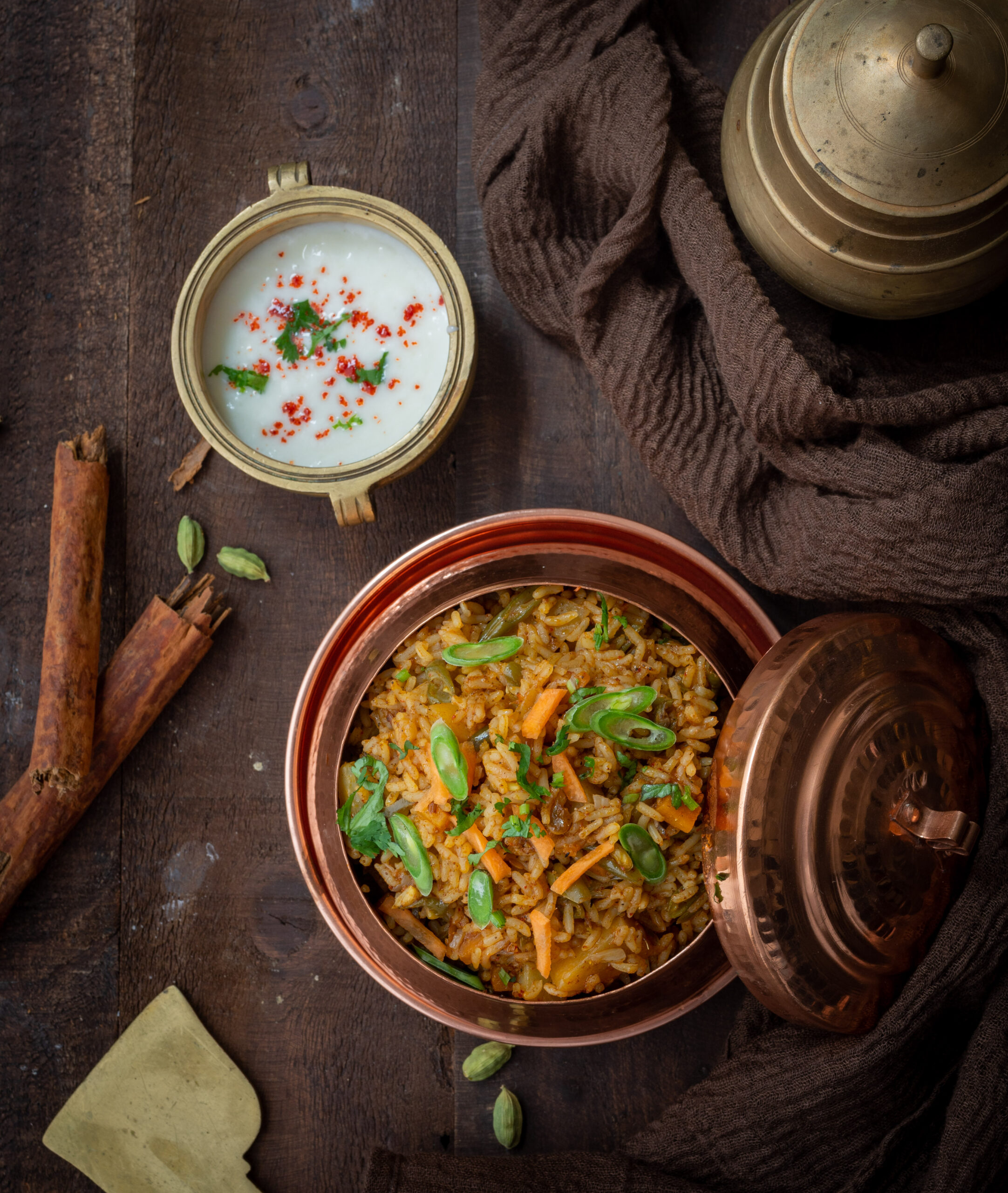
My son prefers chicken biryani, and given that our household is primarily vegetarian, I can attest to how this masala can be used in more than one biryani rendition – to equal success. I have shared a vegetable biryani recipe in the past, which happens to be my own favourite. You can certainly use the biryani masala recipe below for either or both, as well as with other core ingredients.

I realise that these days biryani, once a royal enjoyment, has become a much more accessible and affordable dish. In fact, it is now a widely available form of street food. All around Chennai, I notice tiny little counters and kiosks, if not full-fledged shops, serving biryani. I must confess that I am wary of these. While the food is tasty, I love heaping vegetables to my biryanis and making them as wholesome as possible. This is true even when I am preparing meat versions for my son. Biryani itself is quite a rich, heavy dish, and balancing out the nutrition content is important to me. This is why I choose to make it at home whenever possible, despite the temptation of store-bought meals.

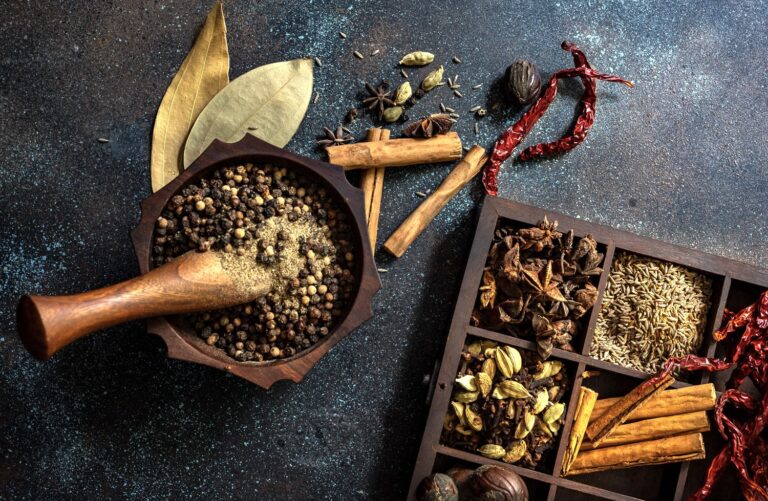
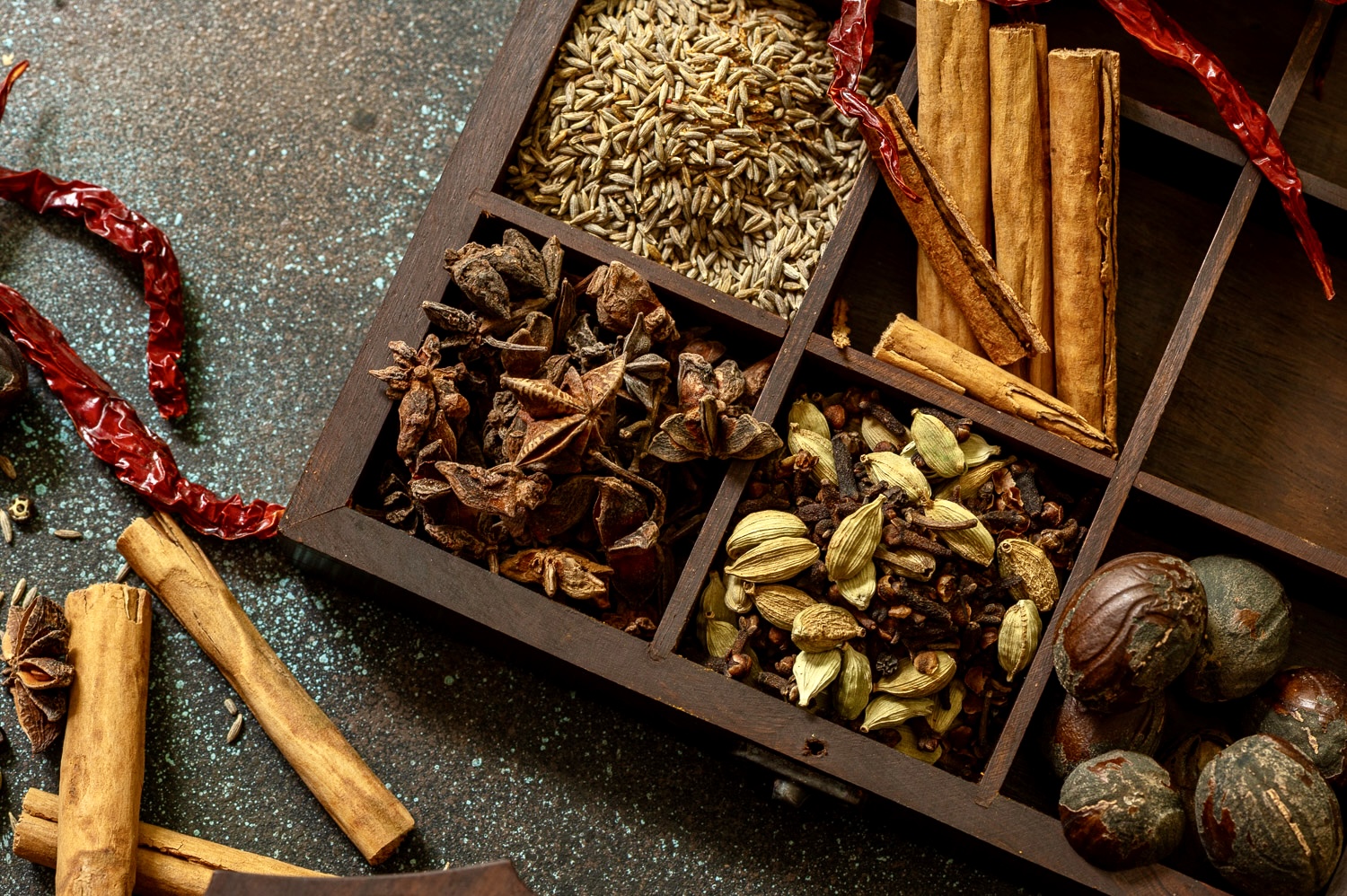
Similarly, making my own spices is something I really enjoy doing. There is nothing like the aroma that rises when they are freshly ground. Those used in biryani masala are either intrinsic, or have at least become traditional, to this part of the world. There is a sense of doing as generations have done for centuries past: putting together a beautiful medley of flavours to add depth and taste to a dish.

There is, for me, also a sense of following in my mother’s footsteps. She told me about how Gujaratis customarily had some kind of basement or pantry for the safe storing of dry provisions, including spices, so that these could be utilized through the year. We didn’t have a basement per se, but she retained this sensibility. Grains and spices were always stored, with the latter prepared during the summer months when roasting them under the blazing sun would be most efficient. Our blender was always busy during that season. It is a practice I have made my own, and despite the conveniences of today, I hope to share the beauty of this practice with as many people as possible too.

Biryani Masala Powder
(Yield: Approximately 1 cup)

2 2-inch cinnamon sticks
10-12 cloves
10-12 green cardamom
3 black cardamom
3 star anise
1 teaspoon black peppercorns
1 tablespoon fennel seeds
8 bay leaves
15 Kashmiri red chilies
1 tablespoon cumin seeds
¼ cup coriander seeds
½ nutmeg
2 mace

Dry roast the cloves, pepper, green cardamom and black cardamom on a slow flame. Once they release an aroma, remove onto a plate.

Next, dry roast the coriander seeds, fennel seeds, cumin seeds, nutmeg and mace. Once they release an aroma, remove onto a plate.

Finally, roast the bay leaves, cinnamon, red chillis, and star anise. Keep stirring on a low flame.

Allow all the ingredients to cool, then transfer to a blender. Powder and store in airtight jar at room temperature.

I like to always fill just a small jar, so that whatever spice or spice mix powder is contained within is consumed while the aromas are still quite fresh. I would recommend using up each batch within a month.

I hope this biryani masala powder becomes a part of many feasts in your life. You may also wish to explore other spice powders and blends I have shared earlier, including sambar podi, garam masala, curry leaf podi  and coconut podi.

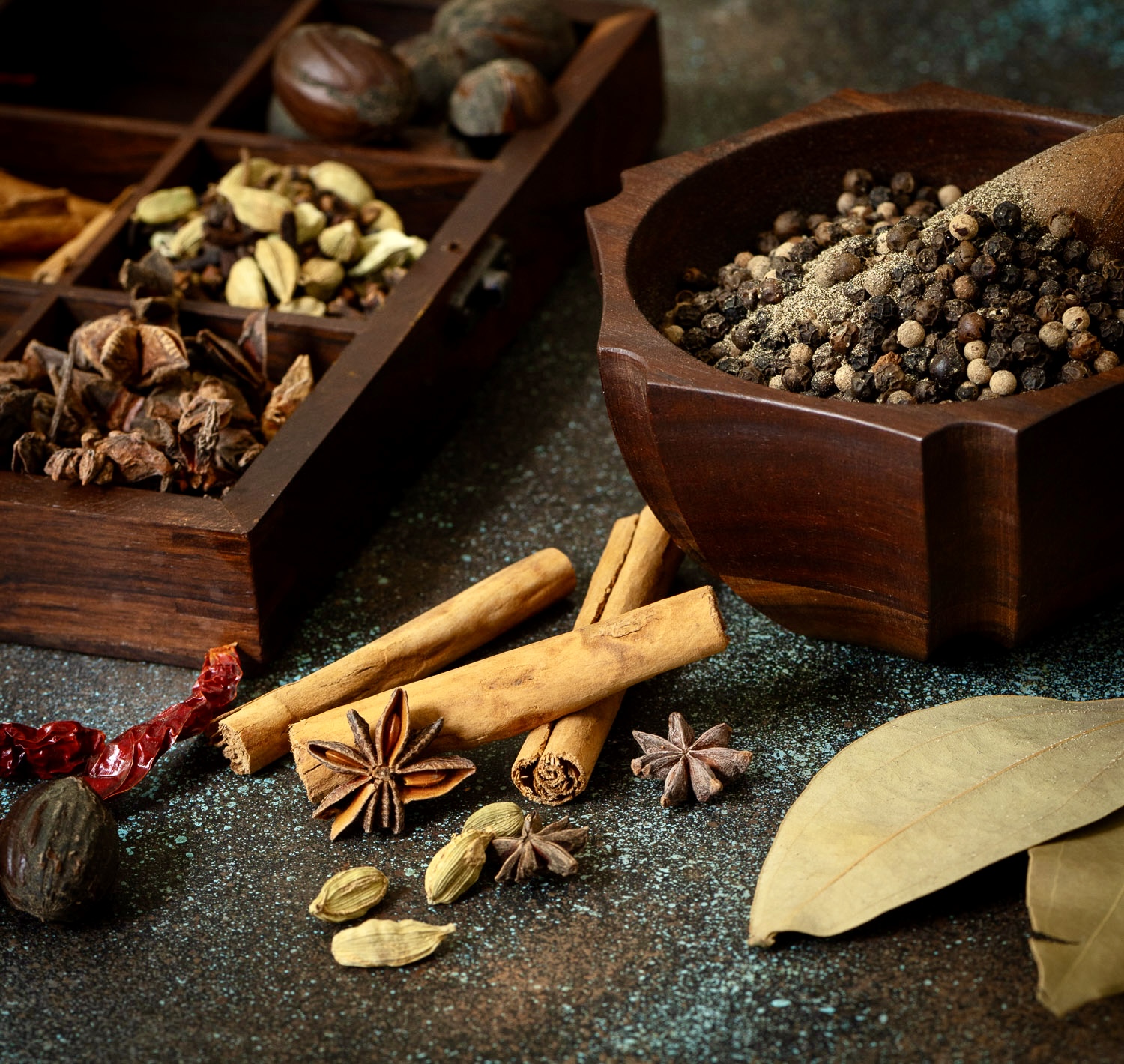
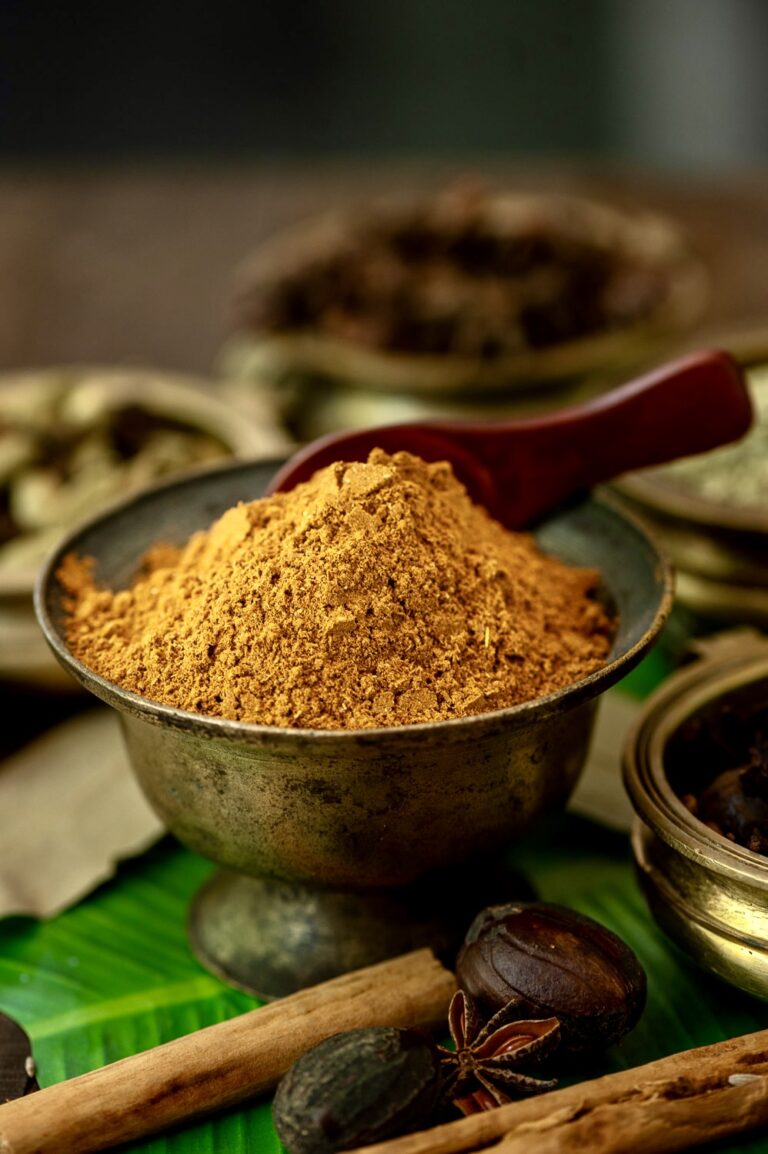
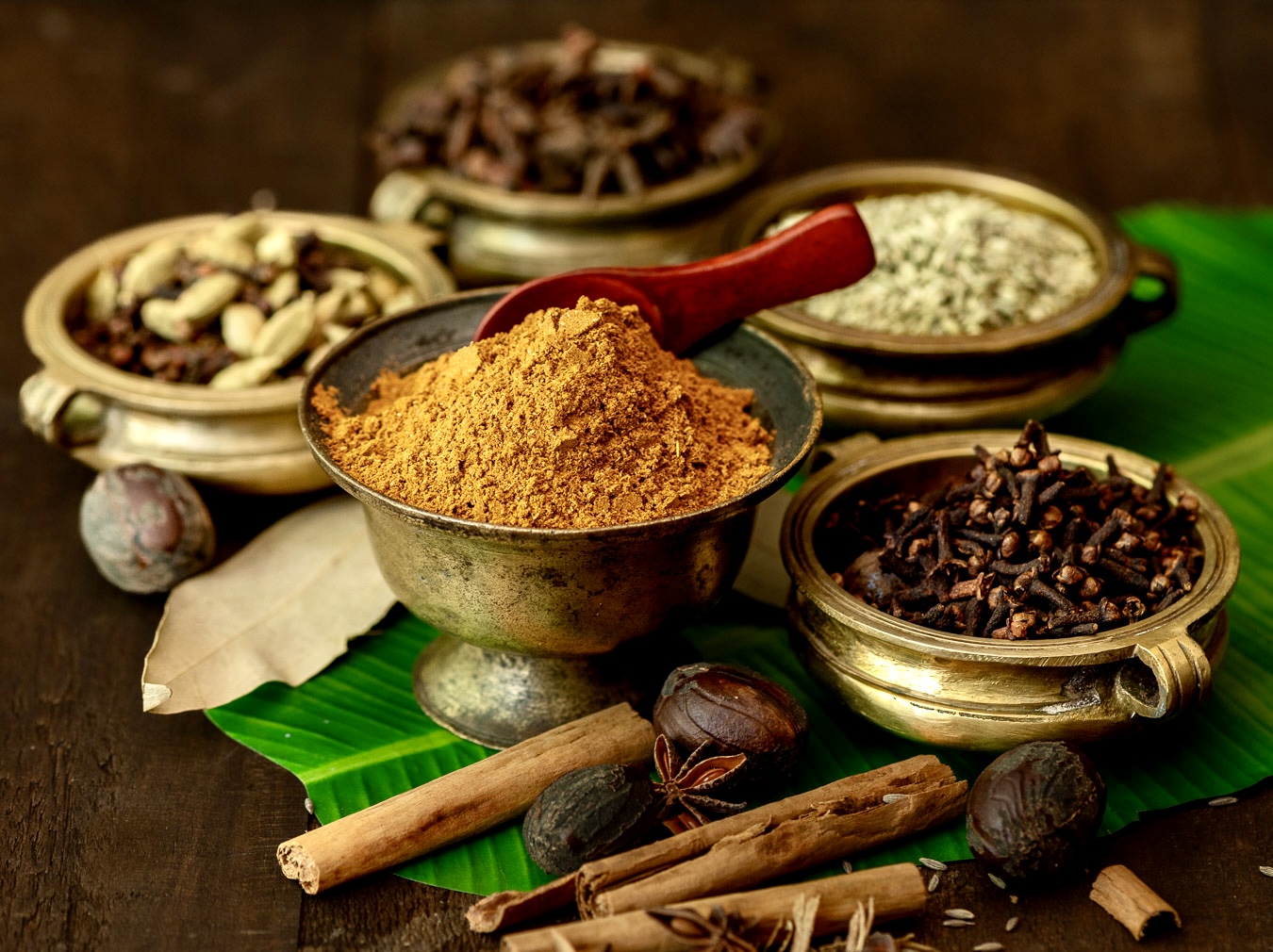
Garam masala is one of India’s quintessential spice blends, a staple of the Punjabi kitchen and popular in the north of the subcontinent. Traditional Gujarati and Tamil cuisines don’t use it, which means it is not a masala that features regularly in my own cooking. That said, I do enjoy the flavour profile immensely in certain dishes. Until recently, I would purchase readymade garam masala, but an increasing number of spice adulteration scares in India when it comes to commercial brands have convinced me that it is safer to prepare it at home myself. I found the process easy and the outcome fulfilling, and in some ways, this means that garam masala features a little more often in the recipes I choose too.

There is a vast amount of nuance when it comes to Indian spicing techniques and spice blends. There are differences between whole forms and powdered versions, and seasonality and availability also have an impact on what became considered traditional. Certain combinations are region-specific. Additionally, while many assume that red chillies are the base spice, this is historically inaccurate. The chilli family came to the subcontinent with the Portuguese. The core spice in this part of the world prior to this was pepper.

Garam masala has had only a scattering of appearances on this blog, used sparingly for dishes like roast potatoes and radish paratha. I have also used it in place of chana masala when making chole, rather than buying readymade chana masala. It traditionally features in black dal, moong dal and even certain meat preparations. I find that the flavour is very potent, so it is best to use a very small quantity, especially when the blend is homemade, as it will be purer. Adjust the quantity as required, based on your preferences and on what the dish calls for.

Nowadays, I roast the spices, but I clearly remember when my mother used to dry them in the sun in the summer heat. We were fond of chana and black dal and rarely went to restaurants, so garam masala was definitely a presence in her kitchen cabinet too. As I have said many times over many posts, my cooking skills came from her. She was as fond of exploring different cuisines and increasing her own repertoire as I am.

You may recall from prior posts that the more elaborate method of sun-drying is also something I do now and then or for specific spices, but this is of course climate-dependent. I presume that exposure to the elements may add more to the flavour, but overall I certainly lean towards homemade rather than storebought and that fact alone elevates any powder I prepare – roasted or sun-dried. I always make my powders in bulk, not only so that they may be used for a longer period, but also so that I can give them to my kids, who will utilise the same in their own kitchens. This gorgeous garam masala is now in all the places they live, and perhaps will be welcome in your home too.

Garam Masala
(Yield: Approximately 1 cup)

½ teaspoon nutmeg
2 strands mace
4 cloves
¼ cup coriander seeds
2 tablespoons cumin seeds
½ tablespoon black pepper corn
1 tablespoon fennel seeds
¼ teaspoon ajwain (carom) seeds
1 teaspoon methi (fenugreek) seeds
4-5 whole cardamom
6 cinnamon sticks
2 star anise

Begin by roasting all the big ingredients on a low flame. These would be cinnamon, star anise, nutmeg and mace. Add the smaller grains second: cardamom, methi, fennel, cumin, ajwain, coriander, pepper, cloves.

Once the ingredients release their fragrance, turn off the stove and remove the pan from the flame.

Allow to cool and blend in a spice grinder.

Store in an airtight glass jar. Use in curries of your choice for a well-rounded and deep flavour.

Over the years, I have shared numerous spice powder recipes, from to curry leaf podi to coconut podi and more. More will soon follow, so do stay connected!